
In this article
Recent Posts
Supply Chain Mithileshkumar R NaikJul 6, 20267 min read
Counterfeit vs Grey Market vs Unauthorized Sale: What’s the Difference?
 Mithileshkumar R NaikJul 6, 20267 min read
TL;DR
A brand manager gets a complaint: a customer bought their product online, and it turned out to be “fake.” Except when the team pulls the listing, the product isn’t fake at all. It’s genuine stock, sitting in a warehouse it was never supposed to reach, sold by someone the brand has never worked with.This mix-up happens constantly, and it costs teams time they don’t have. Counterfeit, grey market, and unauthorized sale get used interchangeably in internal reports, legal notices, and marketplace takedown requests, but they’re three different problems with three different fixes. Send a counterfeit-removal notice for a grey market listing and a marketplace will reject it, because the product isn’t fake. Treat an unauthorized reseller like a counterfeiter and you’ll burn a partnership you might have wanted to repair instead.- Counterfeit, grey market, and unauthorized sale get used interchangeably, but they’re three different problems that need three different responses.
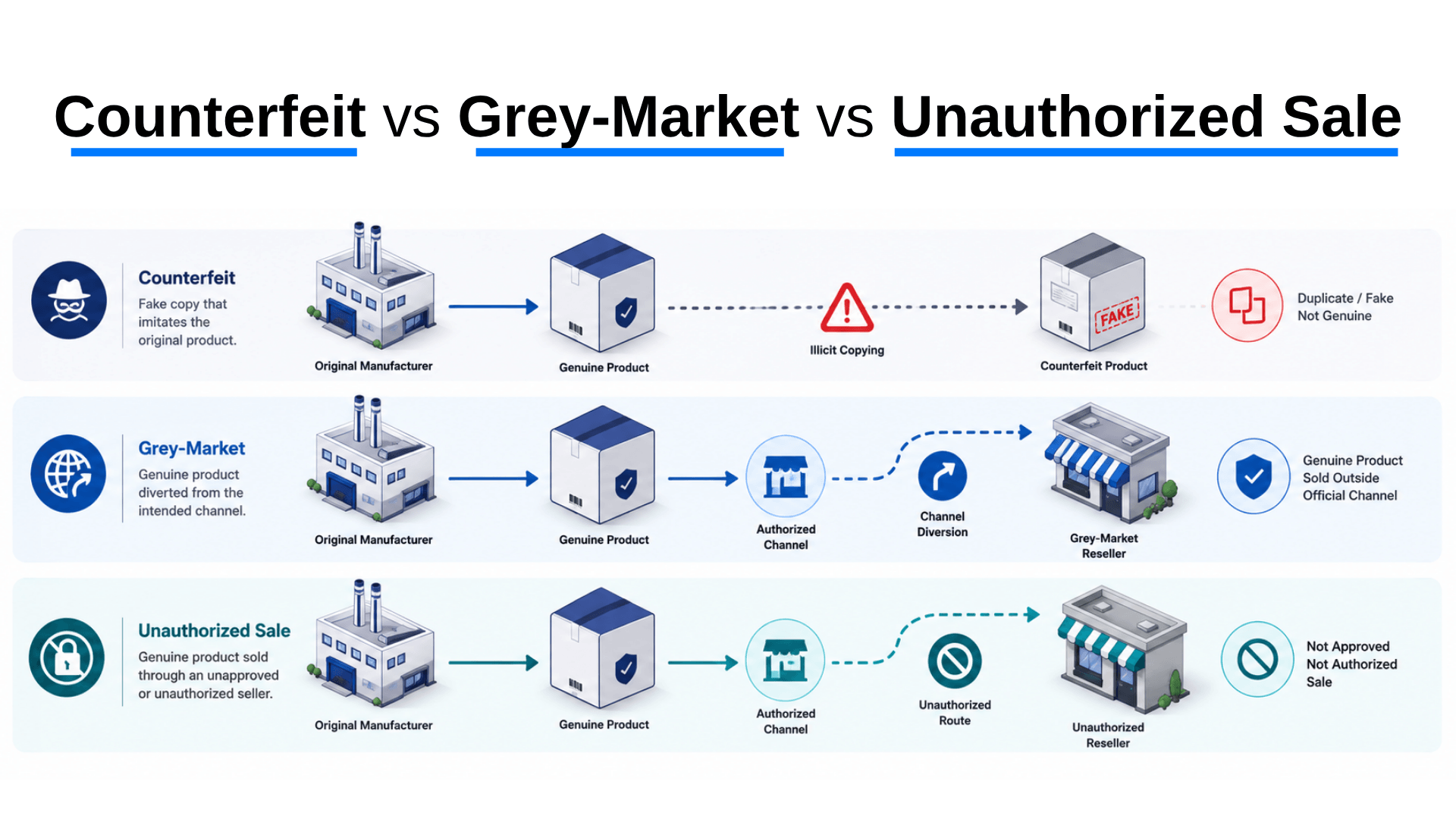
- Counterfeit means the product itself is fake, no relationship with the brand, straight infringement.
- Grey market goods are genuine, just moved through a channel the brand never intended, which is why warranty claims get rejected even on real products.
- Unauthorized sale is the broadest category: a genuine or grey-market product sold by someone the brand never approved, outside the distribution agreement.
Counterfeit: the product itself is fake
A counterfeit is straightforward to define, even if it’s hard to catch. It’s a product made to imitate a brand without permission: fake packaging, a copied logo, sometimes a formulation that doesn’t match the original at all. The seller has no relationship with the brand, legitimate or otherwise. There’s no channel to speak of. It’s straight infringement.This is the one everyone assumes they’re dealing with when something goes wrong. In practice it’s often the least common of the three, especially for established brands running any kind of product authentication.Grey market: real goods, wrong channel
Grey market goods are genuine. That’s the part people miss. A distributor with surplus stock in one country sells it to a reseller who ships it somewhere else, a different region, a different price tier, sometimes a different country entirely. The product itself hasn’t been touched. It’s just moved through a channel the brand never intended for it.Buyers usually can’t tell anything is wrong until they try to claim a warranty and get turned away, because the product was never meant to be sold where they bought it. For a deeper look at how this plays out, see grey market and its underlying cause, product diversion.Unauthorized sale: the seller broke the agreement
Unauthorized sale is the broadest of the three, and it’s the one that swallows the other two in casual conversation. It just means a product was sold by someone the brand didn’t approve to sell, through a channel outside the distribution agreement. That’s it. The product can be genuine. It can even be grey market stock. The defining fact is that the seller had no right to sell it there, at that price, or at all.A distributor licensed for one state selling into another is an unauthorized sale. A former reseller who lost their agreement but kept listing inventory is an unauthorized sale. An employee moving samples on the side is an unauthorized sale. Grey market activity is technically a subset of this, but not every unauthorized sale involves the cross-border diversion that defines grey market specifically. See unauthorized sale for the full breakdown.
See Acviss in action
Knowing which of the three you’re dealing with determines whether a takedown notice actually works. Acviss helps tell them apart before you send one. Footwear is one of the categories where this distinction matters most — covered in our piece on counterfeiting in the footwear industry.
Explore AcvissSide by side
| Term | Are the goods genuine? | Is the seller authorized? | Legal status | Typical brand remedy |
|---|---|---|---|---|
| Counterfeit | No | No | Trademark/IP infringement | Takedown, legal action |
| Grey Market | Yes | No | Usually a contract issue, not a crime | Channel enforcement, geofencing |
| Unauthorized Sale | Usually yes | No | Contract breach; sometimes regulatory | Agreement enforcement, channel audit |
Why the distinction actually matters
Get this wrong and the response is wrong too. A marketplace takedown request for counterfeit goods needs proof the product is fake, evidence that doesn’t exist for grey market or unauthorized sale cases, because the product is real. Warranty policy differs across all three: a counterfeit gets no warranty because it was never the brand’s product, grey market goods might get a modified warranty depending on jurisdiction, and unauthorized sale sits somewhere in between depending on what the original distribution contract actually said.In regulated industries like pharma and agrochemicals, the line matters even more. An unauthorized sale of a genuine drug into a market where it isn’t approved can trigger a compliance investigation that has nothing to do with counterfeiting at all. Global counterfeit trade is enormous on its own: the OECD and EUIPO’s 2025 Mapping Global Trade in Fakes report put counterfeit and pirated goods at USD 467 billion in global trade, which gives some sense of how much room there is for these categories to get tangled together at scale.How Acviss tells them apart
The reason these three get confused in the first place is that most brands find out about the problem after the sale, from a customer complaint or a partner dispute. By then there’s no way to tell whether the product came from a counterfeiter, a diverted shipment, or a distributor who broke their contract.With supply chain traceability, every unit carries a record of where it was meant to go: which distributor, which territory, which price tier. When a product surfaces outside that path, the record shows exactly what kind of problem it is. A fake unit that was never legitimately manufactured. A genuine unit diverted across regions. A genuine unit sold by a partner who broke the rules. That distinction decides whether the next step is a legal takedown or a conversation with a distributor.Online, the same visibility extends through marketplace monitoring and takedowns, so listings that don’t match an authorized seller or approved territory get flagged before they reach many buyers, rather than after the complaints start. For more on spotting these listings in the first place, see how to detect unauthorised sellers on online marketplaces.A quick way to tell which one you’re facing
Before escalating a complaint or drafting a takedown notice, run through these three questions:- Is the product itself fake? Check materials, serialization, batch codes against known-genuine units. If yes, it’s counterfeit, full stop, go straight to legal or takedown.
- If it’s genuine, did it cross a region or price tier it wasn’t meant for? A product manufactured for one market showing up cheaper in another, still authentic, still boxed correctly, that’s grey market.
- If it’s genuine and stayed in its intended market, who sold it? If the seller has no agreement with the brand, or violated the terms of one they did have, that’s an unauthorized sale, even if the product never left its home region.
Common questions
Can one product be a victim of all three at once? Not literally, but the categories can chain together. A genuine product diverted to the grey market can end up in the hands of an unauthorized seller, who then lists it next to actual counterfeits on the same marketplace page. Untangling which listing is which is exactly why unit-level tracing matters more than treating the whole page as one problem.Does a customer even notice the difference? Rarely, and that’s the point. A customer who gets a grey market unit or an unauthorized-sale unit usually experiences the same thing: a denied warranty claim, confusion about where the product came from, and a support ticket that lands on the brand’s desk regardless of which category caused it.Which one is hardest to prove? Unauthorized sale, generally. Counterfeit is provable by testing the product. Grey market is provable by checking regional batch codes. Unauthorized sale often comes down to reading a distribution contract and proving where the chain broke, which is slower unless the brand already has channel-level tracking in place.The takeaway
Not every problem with your distribution is a counterfeiting problem, and treating them the same way wastes the one advantage you have: knowing exactly what you’re dealing with. Counterfeit means the product is fake. Grey market means genuine goods moved through the wrong channel. Unauthorized sale means someone sold without the right to. Different problems need different fixes, and telling them apart starts with knowing where your product actually went.Want to see which one is hitting your business? Book a demo to trace your products back to their source.
Not sure if it’s counterfeit, grey market, or an unauthorized reseller?
Book a free demo and see how Acviss tells the three apart, so your takedown notices and partner conversations actually land.
Book a Free DemoMore like this on:Supply Chain
Related reading

Traceability Software: What to Look for Before You Buy
Search “traceability software” and you’ll get a wall of vendors that all claim real-time visibility, blockchain-backed rec

Instant Supply Chain Tracking: What It Actually Takes
“Instant” and “supply chain tracking” don’t usually belong in the same sentence for most brands. Real-time vis