

- Why Packaging Line Problems Are Difficult to Diagnose
- 10 Common Packaging Line Problems and How to Fix Them
- Packaging Line Metrics Worth Tracking
- How Authentication and Traceability Fit Into the Packaging Line
- A Practical Packaging Line Troubleshooting Process
- Connect Packaging Performance With Product Intelligence
Common Packaging Line Problems and How to Fix Them
 Mithileshkumar R NaikJun 8, 20266 min read
- Common packaging line problems include label misalignment, adhesive failure, and inconsistent print quality, all of which can undermine security features.
- A security label that peels, smudges, or misapplies on the line defeats its purpose before the product even reaches the shelf.
- Line speed and material compatibility need to be tested with the actual security label, not assumed from a generic packaging spec.
- Fixing these issues at the source protects both product presentation and the integrity of the authentication feature itself.
Common packaging line problems rarely begin as dramatic failures. They often start as a printer that pauses for a fraction of a second, a label that shifts slightly, a scanner that rejects more packs than usual, or a downstream machine that cannot keep pace. These small losses accumulate into missed targets, extra waste, unreliable product data, and avoidable quality risk. These are exactly the shop-floor problems that an ERP system never sees, which is the traceability gap our guide on why ERP isn’t enough for manufacturing traceability covers.
A packaging line connects multiple processes, including feeding, filling, sealing, coding, labelling, inspection, case packing, and palletisation. Because each process depends on the one before it, the slowest or least stable point can limit the entire line.Why Packaging Line Problems Are Difficult to Diagnose
A line can appear to run at its target speed while producing fewer acceptable units than planned. Short stops may not be recorded as downtime. Rejects may increase only when the line accelerates. A printer may produce readable codes at startup but lose contrast after extended operation. Operators may compensate manually, hiding the underlying issue until volume increases. Packaging operations also carry quality and compliance responsibilities. The U.S. FDA advises manufacturers to control packaging and labelling operations to prevent product and label mix-ups. FDA guidance also highlights line clearance, inspection, and removal of materials from previous operations before a new run begins. Machine safety remains essential too. OSHA states that packaging machines must meet machine-guarding requirements.10 Common Packaging Line Problems and How to Fix Them
1. Packaging Line Bottlenecks
What happens: One machine or manual process operates below the effective capacity of the rest of the line. Products queue upstream while downstream equipment waits. Common causes: Mismatched machine speeds, slow filling, printer delays, inspection rejects, manual packing, or limited accumulation space. Fix: Measure cycle time and queue growth at every station. Improve the true constraint before increasing speed elsewhere. Adding speed upstream usually creates a larger queue, not more finished products.2. Frequent Micro-Stops
What happens: The line stops for seconds at a time because of sensor faults, small jams, misfeeds, or operator adjustments. Each event seems minor, but the total loss can be large. Fix: Record micro-stops separately from major downtime. Group them by machine, reason, SKU, material, and shift. Repeated short stops often reveal a specific mechanical alignment or material-handling problem.3. Poor Print or Code Quality
What happens: Batch codes, expiry dates, barcodes, or serial numbers become faint, distorted, incomplete, or unreadable at production speed. Common causes: Incorrect printer settings, dirty printheads, substrate variation, vibration, poor contrast, or insufficient drying time. Fix: Verify codes inline under real operating conditions. GS1 recommends verification of 2D symbols against its specifications, not relying only on whether a phone can scan them. Connect inline printing with automatic inspection and rejection.4. Inconsistent Label Placement
What happens: Labels wrinkle, skew, lift, or move outside the inspection camera’s expected area. Fix: Check applicator alignment, web tension, sensor position, product spacing, adhesive suitability, and packaging surface condition. Test at minimum, normal, and maximum sustainable speeds.5. High Reject Rates
What happens: Inspection systems reject too many acceptable products or fail to reject real defects. Fix: Separate true defects from false rejects. Validate camera lighting, trigger timing, code grading thresholds, product presentation, and reject confirmation. Never disable inspection simply to improve output numbers.6. Slow Product Changeovers
What happens: Switching SKUs, pack sizes, labels, or coding data consumes more time than planned. Fix: Standardise changeover steps, prepare materials before shutdown, use recipe-controlled settings, and measure internal versus external changeover work. Perform documented line clearance to prevent old labels or products entering the next run.7. Product and Label Mix-Ups
What happens: The wrong label, leaflet, carton, batch data, or product variation enters a run. Fix: Use controlled material issue, barcode verification, electronic recipe selection, line clearance, and reconciliation. FDA labelling guidance emphasises inspection and clearing previous materials where mix-ups could occur.8. Serialisation and Data Synchronisation Errors
What happens: Codes print correctly but are not associated with the right product, batch, case, pallet, or commissioning status. Fix: Validate code generation, printer communication, verification, rejection, commissioning, and aggregation as one connected workflow. Use controlled retries so a communication failure does not create duplicate or untracked identities. Learn how product serialisation supports unit-level traceability.9. Packaging Material Variation
What happens: Different rolls, cartons, bottles, labels, or films behave differently on the same machine. Fix: Define measurable incoming-material specifications, record supplier and lot data, and compare defects against material lots. Packaging equipment settings cannot permanently compensate for uncontrolled material variation.10. Unplanned Downtime and Weak Maintenance
What happens: Wear, contamination, loose connections, failing sensors, or poor lubrication cause unexpected stops. Fix: Build preventive maintenance around actual failure patterns. Inspect high-risk components after maintenance and before release. FDA CGMP guidance notes that equipment maintenance and cleaning must prevent malfunctions or contamination that could affect product quality.
See Uniqolabel in action
See how Uniqolabel’s holographic security labels hold up to real production-line conditions.
Explore UniqolabelPackaging Line Metrics Worth Tracking
| Metric | What It Reveals |
|---|---|
| Good units per minute | Actual saleable output, not theoretical machine speed |
| Micro-stops by cause | Repeated small losses hidden inside a shift |
| Reject and false-reject rate | Quality failures and inspection-system accuracy |
| Changeover duration | Lost production time between SKUs |
| Code verification rate | Print quality and data reliability |
| Mean time between failures | Equipment reliability and maintenance effectiveness |
How Authentication and Traceability Fit Into the Packaging Line
Adding unique product identities changes a packaging line from a purely physical process into a connected data operation. Each code must be generated, printed or applied, verified, activated, and linked to the correct product information. When needed, unit identities are aggregated into cases and pallets. Acviss Certify supports unit-level product authentication, helping brands give each product a secure, verifiable identity. Acviss Origin connects serialised products to supply chain events for traceability, diversion monitoring, and recall readiness. These systems work best when integration begins with a realistic assessment of line speed, printing equipment, inspection capability, reject handling, and data flow.A Practical Packaging Line Troubleshooting Process
- Define the loss clearly. Use good output, rejects, stops, or changeover time instead of a general statement that the line is slow.
- Observe the full line. A downstream symptom may begin several stations earlier.
- Collect evidence by SKU and shift. Problems often follow specific materials, products, settings, or operating conditions.
- Fix one constraint at a time. Multiple simultaneous changes make the real cause difficult to confirm.
- Validate at sustainable line speed. A fix that works only during a slow trial is not complete.
- Standardise and monitor. Update work instructions, settings, maintenance tasks, and alert thresholds.
Connect Packaging Performance With Product Intelligence
Acviss helps brands add authentication and traceability to packaging operations without treating production and supply chain data as separate systems. Book a Demo
Fix packaging line problems before they cost you
Book a free demo and see how Uniqolabel’s labels are built for real packaging lines.
Book a Free DemoRelated reading

How to Track Transport Goods Across Your Supply Chain
If you manufacture or distribute physical goods, you already know the moment a shipment leaves your factory gate is also the moment your vis
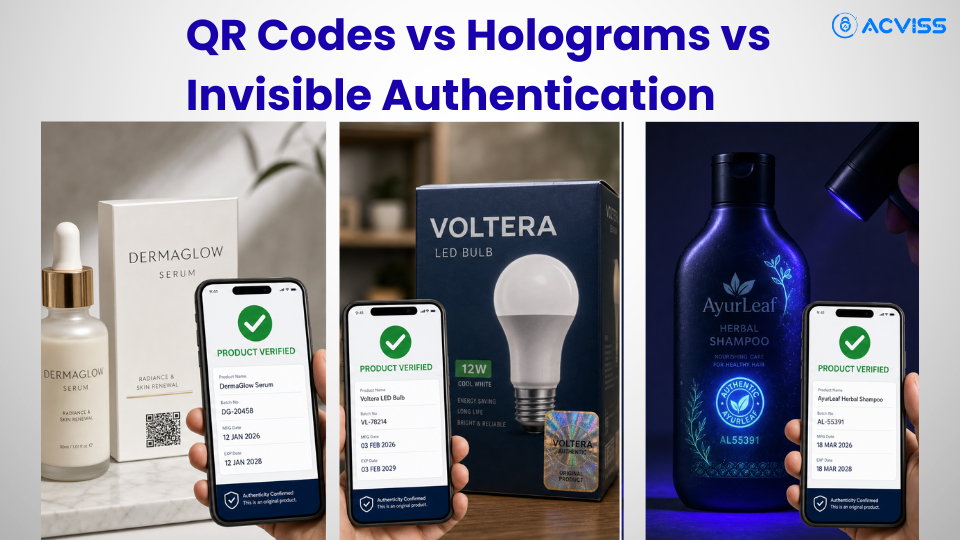
QR Code vs Hologram Label vs Invisible Layer For Your Brand
In this article Overview: Three Authentication Methods Side by Side QR Code Authentication: Strengths, Weaknesses, and When to Use It