

- Grey Market vs Counterfeit: Why Brands Confuse Them and Why It Matters
- How Grey Market Diversion Happens in India
- Signs Your Products Are in the Grey Market
- Industries Most Affected by Grey Market Diversion in India
- The Revenue Impact of Grey Market Diversion
- How to Detect Grey Market Diversion: Manual Signals vs Technology-Based Detection
- How Origin’s Geofencing and Serialization Prevents Grey Market Diversion
- Frequently Asked Questions
- Stop Grey Market Diversion Before It Erodes Your Margins
How Grey Market Diversion Steals Indian Brand Revenue
 Mithileshkumar R NaikMay 19, 202612 min read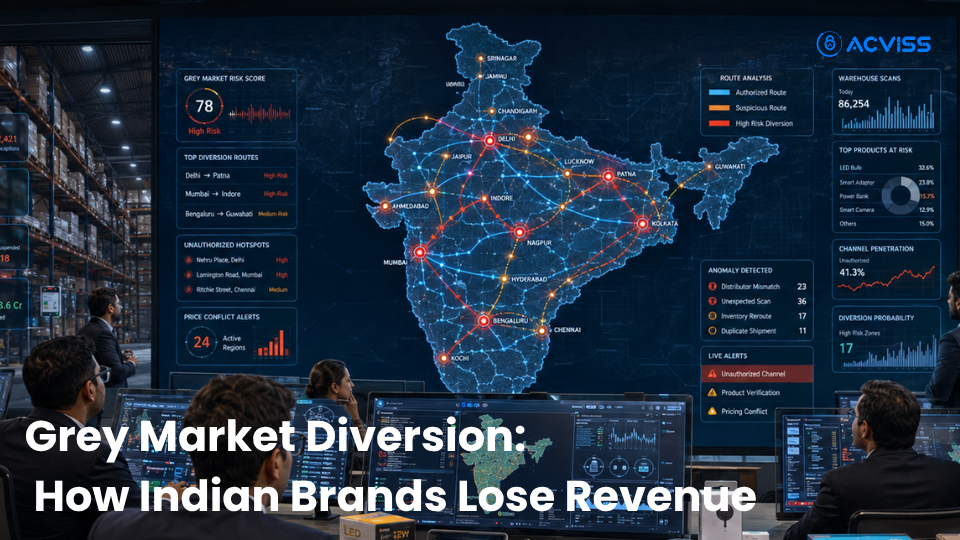
- Grey market diversion is genuine product sold through unauthorized channels, distinct from counterfeiting, so it needs a supply chain fix rather than a packaging one.
- It shows up as price inconsistencies across regions, unexpected warranty claims from unauthorized territories, and distributor complaints about undercut pricing.
- FMCG, pharma, electronics, and automotive parts see disproportionately high diversion due to complex multi-tier distribution.
- Serialization and geofencing let brands trace exactly which handoff point a diverted unit leaked from, without overhauling the entire distribution network.
What-is-Grey-Market-Diversion-How-Indian-Brands-Lose-Revenue-Without-Knowing
When your product shows up on a marketplace at 30% below your official MRP, your first instinct might be to call it a counterfeit problem. But here is what makes grey market diversion harder to catch and more insidious in the long run: the product is real. It is your product, manufactured by you, carrying your brand name, sealed in your packaging. The only thing wrong is where and how it was sold. Diversion is one piece of a wider anti-counterfeiting strategy — see our overview of how Acviss squeezes the counterfeiter’s world down to zero.
Grey market diversion happens when legitimate, authorized products reach consumers through unauthorized channels. No one tampered with the product. No one replicated your label. Your own supply chain made this happen, and your brand is paying the price.
For supply chain heads and brand managers across India, grey market diversion is one of the most underreported and underfunded problems in brand protection. It rarely makes the news the way counterfeiting does. But the revenue losses, the distributor conflict, and the erosion of consumer trust add up quickly. This post explains how it happens, how to detect it, and what you can do to stop it.
Grey Market vs Counterfeit: Why Brands Confuse Them and Why It Matters
The confusion between grey market and counterfeit products is understandable because the symptom is the same: your product appearing where you did not put it, at a price you did not set. But the cause and the solution are completely different.
A counterfeit product is a fake. Someone copied your brand, your packaging, your product, and is selling an unauthorized imitation. Fighting counterfeits means identifying and removing fake listings, working with law enforcement, and making your product harder to replicate.
A grey market product is genuine. It left your factory, passed through your authorized distribution network, and then leaked out of the intended channel through product diversion. The product reaches a consumer through a distributor who was not supposed to sell in that territory, a retailer who bought overstock from a secondary broker, or an e-commerce seller who sourced the product through an informal chain.
Why does this distinction matter for how you respond? Because fighting grey market diversion means fixing your supply chain visibility, not your packaging security. If you spend budget on holographic labels to fight grey market, you are solving the wrong problem. You need to know where every product unit went after it left your warehouse, and you need to be alerted the moment it surfaces in a geography, channel, or price band it should not be in.
Brands that conflate the two problems often underspend on supply chain traceability and overspend on packaging deterrents, while the grey market quietly grows.
How Grey Market Diversion Happens in India
India’s distribution landscape creates multiple points where grey market diversion can begin. Understanding the mechanics is the first step toward stopping it.
Distributor Selling Outside Territory
Your distribution agreement gives a distributor the right to sell in a defined territory. But if demand in their territory is weak and they have excess inventory, selling outside their zone is financially attractive. A distributor in Tier 2 cities in Maharashtra might redirect stock to a broker in Gujarat to clear their inventory before the next shipment arrives. Your product is now in the wrong market, undercutting your authorized Gujarat distributor.
Overstock Dumps into Secondary Markets
Seasonal products, products with upcoming expiry windows, or products affected by demand forecasting errors generate overstock. Distributors holding excess inventory have a strong incentive to liquidate quickly, even at steep discounts, rather than absorb the cost of returns or write-offs. That inventory often ends up on wholesale markets or discount e-commerce platforms, disrupting official pricing.
Parallel Imports
For brands with international operations, parallel imports occur when your product manufactured for or priced in one country gets imported and sold in another. In India, certain categories like electronics, FMCG, and agro inputs see parallel import activity, where products meant for export markets re-enter India through informal import channels at prices below domestic pricing.
E-Commerce Arbitrage
Online platforms have created a new and fast-moving grey market channel. A seller in one city buys a large quantity of your product from a distributor at trade pricing, then lists it on a major e-commerce marketplace at a price that undercuts your authorized online sellers. The transaction is often difficult to trace because the marketplace only sees the listing, not the sourcing chain behind it.
Export Redirection
Products cleared for export, sometimes at subsidized pricing or with export incentives, are redirected back into the domestic market before they leave the country, or re-imported through neighboring countries. This is particularly a concern for agrochemicals, electronics, and pharmaceuticals.
Signs Your Products Are in the Grey Market
Grey market diversion rarely announces itself. It builds slowly, and by the time the damage is visible, the channel conflict has already deepened. Here are the signs your supply chain team and brand managers should be watching for.
- Price inconsistencies across channels: Your product appears at significantly different prices on different platforms or in different regions, without any authorized promotional activity explaining the difference.
- Warranty and service complaints from unexpected geographies: Consumers from regions where you have no authorized sales are registering warranty claims. They bought your product, but you have no record of it being sold there.
- Distributor conflict and complaints: Authorized distributors in specific regions start complaining about losing sales to sellers offering the same product at lower prices. They may not know the source, but the pricing signals grey market leakage upstream.
- Unexpected product appearance on marketplaces: Your product starts showing up on marketplaces you have not authorized, sold by sellers who are not part of your official channel program.
- Brand perception damage in premium segments: If your product is premium-priced and suddenly available at deep discounts, consumers who paid full price feel cheated. This erodes perceived value even among customers who have never seen the discounted listing.
- Unusually high sell-through in specific distributor zones: A distributor who suddenly places much larger orders than their territory’s demand warrants may be sourcing inventory for cross-territory resale.

See Origin in action
See how Origin’s geofencing and serialization flag diversion before it scales. This overlaps with broader anti-counterfeiting strategy, since diverted goods often piggyback on the same distribution gaps counterfeiters exploit.
Industries Most Affected by Grey Market Diversion in India
 Industries-Most-Affected-by-Grey-Market-Diversion-in-India
While grey market diversion can affect any branded product, certain industries in India see disproportionately high exposure.
FMCG
India’s complex, multi-tier FMCG distribution network, which spans thousands of stockists, sub-stockists, and retailers, creates abundant opportunity for product to leak across territories. High-volume, high-frequency products like packaged foods, personal care, and home care are particularly vulnerable because the volume of transactions makes individual unit tracking impractical without serialization.
Pharmaceuticals
Parallel imports of medicines, products diverted from government supply programs into the private market, and export-market drugs re-entering domestic channels are all documented grey market challenges in Indian pharma. Beyond revenue loss, diversion from temperature-controlled supply chains raises serious safety questions.
Electronics
Consumer electronics and components see significant grey market activity in India, driven by price differentials between markets, import duties, and arbitrage opportunities created by international pricing variation. Laptops, smartphones, and accessories are common grey market categories.
Automotive Parts
OEM spare parts authorized for certain regional markets or export channels are frequently diverted into the general automotive aftermarket, where they compete with both officially distributed OEM parts and counterfeits. This creates a three-way channel problem that is difficult to untangle without product-level serialization.
Agrochemicals
Pesticides, herbicides, and fertilizers licensed for sale in specific states, or priced differently for small farmers versus large commercial buyers, are subject to cross-territory diversion. According to CII and FICCI research, the agrochemical sector experiences significant grey and fake product infiltration, with farmers often unable to distinguish authorized from diverted products.
The Revenue Impact of Grey Market Diversion
The financial cost of grey market diversion is harder to quantify than counterfeiting because the unit sold is still your product. But the downstream damage is real and accumulates across several dimensions.
Channel Conflict and Distributor Disengagement
When authorized distributors see their pricing undercut by grey market supply, they lose confidence in your channel management. Some will reduce their own margins to compete, eroding their willingness to invest in your product. Others will simply reduce their focus on your brand. The long-term channel damage often costs more than the margin lost on diverted units.
The mechanics are specific enough for a distributor to spot, once they know what to look for. Sell-in from the brand stops matching actual sell-out, because diverted stock is filling demand a distributor should have captured themselves. Margins compress in a market with no new competitor and no price change on their end, and most distributors misread this as their own pricing or execution problem rather than diversion. Diverted stock does not announce itself the way a counterfeit eventually does through a warranty mismatch or a failed authentication scan: it is genuine, so it scans fine if anyone even checks. The usual distributor response, cutting price further to hold volume, makes it worse, since it narrows the exact price gap the diverted stock was exploiting rather than closing it.
Price Erosion
Once your product is widely available at below-MRP pricing through grey market channels, raising or maintaining official pricing becomes harder. Consumers who discovered the product at a discount are unlikely to pay full price in the future, and authorized retailers face constant pressure to match grey market rates.
Warranty and Service Fraud
Products diverted outside their intended region often carry warranty entitlements that your authorized service network in the diversion geography is not funded to honor. Your service infrastructure absorbs the cost of servicing products it never sold, and consumers in those regions have a poor service experience that they associate with your brand.
Customer Distrust
Consumers who buy your product through a grey market channel and receive a poor experience, whether due to incorrect regional formulation, missing local-language labeling, or warranty denial, blame your brand, not the unauthorized seller who sold to them.
How to Detect Grey Market Diversion: Manual Signals vs Technology-Based Detection
Brands typically start with manual detection methods: monitoring marketplace listings, gathering field sales reports, and waiting for distributor complaints. These methods have real limits, which is why detection is one of the five steps in our guide to protecting your brand.
Manual marketplace monitoring is reactive. By the time your team spots a grey market listing, the product has been in unauthorized circulation long enough to cause price and channel damage. Field sales reports are subjective and incomplete. Distributors reporting grey market competition may be accurate, or they may be using grey market claims to negotiate better terms. Neither method tells you where in your supply chain the diversion is occurring.
Technology-based detection works differently. When each unit or each case carries a unique, serialized identifier, your supply chain system can record every handoff from factory to shelf. A product that was assigned to a distributor in Chennai appearing in a scan in Kolkata is an anomaly the system flags immediately. You do not need to wait for a complaint; the data tells you the diversion happened, when it happened, and where the product surfaced.
Geofencing adds another layer: you define the geographic boundaries within which each product unit is authorized to be sold or scanned. Any scan outside that boundary triggers an alert to your supply chain team in real time.
How Origin’s Geofencing and Serialization Prevents Grey Market Diversion
 How-Origins-Geofencing-and-Serialization-Prevents-Grey-Market-Diversion
Acviss Origin is a blockchain-based supply chain traceability platform built for exactly this problem. Every product unit is assigned a unique digital identity at the point of manufacture. That identity travels with the product through every stage of the supply chain, and every handoff is recorded on the blockchain, creating a tamper-evident ledger of where the product was, when it moved, and who handled it.
The geofencing capability in Origin allows your supply chain team to assign geographic distribution boundaries to product batches or individual SKUs. If a product assigned to a distributor in Karnataka is scanned in Rajasthan, Origin flags the exception immediately. You can set alert thresholds, assign the alert to a field sales manager, and investigate before the grey market activity scales. Because every scan is recorded with location and timestamp data, you can trace the diversion back to the specific handoff point where the product left its authorized channel.
For brands managing multi-tier distribution across India, Origin replaces the patchwork of spreadsheets, field reports, and after-the-fact audits with a single, real-time view of your supply chain. Brands using Origin have been able to identify which specific distributors or stockists are the source of grey market leakage, address the channel conflict directly, and reduce unauthorized diversion without disrupting their broader distribution network. You can learn more about how Origin works for your supply chain at acviss.com/origin.
Origin’s serialization identifies where a diverted unit left its authorized channel. Pairing it with Certify’s per-unit authentication closes the other half of the gap: a marker that survives resale and repackaging, so a specific diverted unit can still be identified after it changes hands, not just while it stays inside your own recorded supply chain. For a distributor absorbing someone else’s diverted stock, this combination turns a vague sense that pricing is under pressure into a specific, documented answer: this batch, diverted from this point, entering through this channel. That is also what makes an anti-diversion clause in a distribution agreement enforceable in practice, not just on paper.
If you are starting from zero, retrofitting authentication onto stock already in the field is not realistic. The practical first step is usually the next production run: assign per-unit identity going forward, then pick one territory with an unexplained margin problem and run the trace, to see whether the answer is diversion or something else. If you want a faster first pass before running a full trace, 5 Signs Your FMCG Distributor Network Has a Diversion Leak is a quick self-audit checklist for spotting the symptoms.
Frequently Asked Questions
Is grey market diversion illegal in India?
Grey market diversion exists in a legal grey area (the name is not accidental). Selling genuine products through unauthorized channels is not always a criminal offense in India, but it can violate your distribution agreements, and in certain categories like pharmaceuticals it may breach regulatory requirements. The more important question for most brands is not legal liability but commercial damage: grey market diversion costs you revenue, damages your channels, and erodes pricing power regardless of the legal classification.
Can I stop grey market diversion without replacing my entire distribution network?
Yes. Most brands do not need to overhaul their distribution. What they need is visibility. When you can see where each product unit is in real time, and when you can identify which specific distributors are the source of diversion, you can address the problem surgically. Serialization and geofencing technology lets you investigate and act on the actual problem rather than imposing blanket channel changes that disrupt your entire network.
How is grey market diversion different from parallel imports?
Parallel imports are a specific type of grey market activity where products made for one market (often at different pricing) are imported and sold in another market. Grey market diversion is broader and includes any situation where genuine products reach consumers through channels that were not authorized by the brand for that geography or customer segment.
If my products don’t have serialization today, how long does it take to implement?
The implementation timeline depends on your packaging process and the scale of your SKU range. For brands with existing printing infrastructure, adding serialized QR codes or unique identifiers at the production stage is typically faster than most supply chain heads expect. A phased rollout starting with your highest-risk SKUs or highest-risk distribution regions is usually the most practical path. The Origin team at Acviss works through implementation planning with each brand individually.
Stop Grey Market Diversion Before It Erodes Your Margins
Grey market diversion is a supply chain visibility problem. Your products are real, your distributors are authorized, but somewhere between your factory and your consumer, product is leaking into channels you did not sanction and at prices that undermine your brand. The longer it goes undetected, the deeper the channel conflict and the harder the pricing problem becomes to reverse.
Track every product from factory to consumer. Stop grey market diversion before it erodes your margins.
See how Origin gives you real-time supply chain visibility. Book a demo.

Track every product from factory to consumer
Book a free demo and see how Origin gives you real-time supply chain visibility.
Related reading

How to Reserve and Register a Trademark for Your Brand
A brand name isn’t protected just because you’re using it. Until it’s registered as a trademark, anyone else can file for
How to Remove Counterfeits on Meesho, IndiaMart and Myntra
Most brand protection conversations in India focus on Flipkart and Amazon. Those platforms deserve attention, but