
In this article
- The Problem: What Kitply Was Facing
- Why Product Authentication Matters Differently for Construction Materials
- The Solution Kitply Deployed
- The Result: Production and Sales Both Up
- What Changed in Kitply’s Operations After Deployment
- Lessons for Other Manufacturing Brands
- Industries Where Similar Results Are Possible
- See What Product Authentication Could Do for Your Brand
Recent Posts
Case Studies Mithileshkumar R NaikMay 29, 202610 min read
How Kitply Doubled Sales Implementing Product Authentication
 Mithileshkumar R NaikMay 29, 202610 min read
TL;DR
Kitply Industries is one of the most recognized names in Indian plywood. Decades of market presence, a reputation built on quality, and distribution networks reaching contractors, architects, and builders across the country. In a market where brand trust is everything, Kitply had built something valuable and hard to replicate.
Then the fakes arrived.
Counterfeit Kitply products began circulating in trade channels. They looked close enough to the genuine article to fool buyers who did not know exactly what to look for. They were priced lower, which made them attractive to cost-sensitive distributors and contractors. And they carried the Kitply name, which meant every failure of a counterfeit sheet was logged in a customer’s mind against the genuine brand.
This is the story of what Kitply did about it, what changed after they deployed Acviss Certify, and what it means for other manufacturing brands facing the same problem.
- Kitply, a plywood manufacturer, faced counterfeit products undercutting genuine sales and eroding customer trust.
- Implementing product authentication gave customers a simple way to verify genuine Kitply products before purchase.
- Visible verification technology reassured distributors and retailers, strengthening the entire sales channel, not just end consumers.
- The result was a measurable doubling of sales, tied directly to restored trust in product authenticity.
The Problem: What Kitply Was Facing
Counterfeit plywood is not a new problem in India. The construction materials market is fragmented, distribution chains are long, and enforcement at the retail and trade level is inconsistent. For a brand like Kitply, with strong recognition and a premium positioning, these conditions create a specific kind of vulnerability. When a brand is well-known enough that fakes are commercially viable, the counterfeiting operation does not need to be sophisticated. It needs to be close enough. Packaging that mimics the original, quality that appears adequate on a brief inspection, and a price that makes a distributor or contractor willing to look past their doubts. That is enough to move product at scale. The impact on Kitply played out across several levels. At the distribution level, genuine Kitply dealers found themselves competing against their own brand name. A contractor who could buy “Kitply” at a lower price from an unauthorized source had less reason to pay the genuine dealer’s price. The genuine dealer lost the sale, and the brand lost a legitimate transaction. At the contractor level, the confusion was practical and professional. A contractor who wanted to specify genuine Kitply to a client had no reliable way to verify that what they were buying was the real product. The visual similarity of good fakes made product checks unreliable. Recommendations from genuine dealers were undermined when buyers could claim to have found the same product at lower prices elsewhere. At the brand level, the damage was slower but more lasting. Each counterfeit product that underperformed in a construction application was a negative data point attached to the Kitply name. Contractors who experienced failures with fake Kitply did not always know they had bought a fake. They knew that Kitply had let them down. That association is difficult to reverse once it forms at scale.Why Product Authentication Matters Differently for Construction Materials
 Counterfeit plywood is not the same category of problem as counterfeit cosmetics or counterfeit apparel. It has a safety dimension that the brand protection conversation does not always capture adequately.
Plywood is a structural material. It is used in flooring, furniture framing, wall panelling, formwork for concrete, and load-bearing applications in residential and commercial construction. The mechanical properties of plywood, its load-bearing capacity, resistance to moisture, adhesive bond strength, and consistency of thickness, are not cosmetic attributes. They are the attributes on which structural decisions are made.
A counterfeit plywood sheet that uses lower-quality wood veneer, substandard adhesives, or inadequate pressing will meet certain visual requirements while failing mechanically in ways that a contractor or buyer cannot detect at the point of purchase. The failure manifests later, during use, when it is expensive or dangerous to address.
This means that for construction material brands, the argument for authentication is not just about revenue protection. It is about ensuring that products carrying your brand name in the market actually meet the engineering specifications your brand represents. A fake product installed in a load-bearing application under your brand name is a liability, a safety risk, and a reputational exposure that no brand manager wants to defend.
The case for product authentication in this context is not difficult to make. The harder question has always been: what kind of authentication system will actually work in the construction trade channel, where buyers are contractors and distributors rather than retail consumers?
Counterfeit plywood is not the same category of problem as counterfeit cosmetics or counterfeit apparel. It has a safety dimension that the brand protection conversation does not always capture adequately.
Plywood is a structural material. It is used in flooring, furniture framing, wall panelling, formwork for concrete, and load-bearing applications in residential and commercial construction. The mechanical properties of plywood, its load-bearing capacity, resistance to moisture, adhesive bond strength, and consistency of thickness, are not cosmetic attributes. They are the attributes on which structural decisions are made.
A counterfeit plywood sheet that uses lower-quality wood veneer, substandard adhesives, or inadequate pressing will meet certain visual requirements while failing mechanically in ways that a contractor or buyer cannot detect at the point of purchase. The failure manifests later, during use, when it is expensive or dangerous to address.
This means that for construction material brands, the argument for authentication is not just about revenue protection. It is about ensuring that products carrying your brand name in the market actually meet the engineering specifications your brand represents. A fake product installed in a load-bearing application under your brand name is a liability, a safety risk, and a reputational exposure that no brand manager wants to defend.
The case for product authentication in this context is not difficult to make. The harder question has always been: what kind of authentication system will actually work in the construction trade channel, where buyers are contractors and distributors rather than retail consumers?
The Solution Kitply Deployed
Kitply implemented Acviss Certify, Acviss’s product authentication solution built on a patented non-clonable 2D code technology. Each product, whether at the sheet or bundle level, carries a Certify authentication label. The label cannot be cloned. A counterfeiter cannot scan the code from a genuine product and reproduce it on fakes, because the code’s properties cannot be duplicated by standard printing processes. This is the foundation: authentication that holds up against the level of sophistication the counterfeit market in Indian construction materials actually presents. Verification was designed for the trade channel rather than retail consumers. A contractor or distributor who wants to verify a product does not need to download an app. They scan the code with their phone’s standard camera, or send a message via WhatsApp, and they get an immediate verification response: genuine or suspect. The no-app requirement matters in a market where demanding an app download as a condition of verification is a significant adoption friction point, especially for contractors working on sites. For Kitply’s own team and for authorized dealers, Certify provides real-time counterfeit alerts. When a code is flagged as suspect or when a code is scanned multiple times in a pattern that suggests a duplicated label, the system generates an alert. The location data from scan events gives the sales and brand protection team a live view of where suspicious activity is concentrated. This last capability transforms the enforcement conversation. Instead of relying on distributor reports and field observations to identify counterfeit hotspots, Kitply’s team has data-driven signals that direct investigation to specific geographies and trade channels.
See Certify in action
See how Certify helped Kitply build customer trust and grow sales. Kitply’s approach centred on visible overt authentication that customers could check themselves at the point of sale — one of several approaches covered in our complete guide to product authentication.
Explore CertifyThe Result: Production and Sales Both Up
Rajshekhar, Sales Head at Kitply Industries, stated: “Our Production and sales are up, I am extremely happy with Acviss.” That statement is worth unpacking, because the connection between product authentication and production and sales growth is not immediately obvious. Understanding the mechanism explains why the result is replicable for other manufacturing brands. When counterfeit products circulate in a market under your brand name, genuine sales are suppressed in ways that your normal sales reporting does not capture clearly. Some of those suppressed sales are direct: a buyer who would have bought genuine Kitply buys a counterfeit instead. Your production volume drops not because demand has fallen, but because a counterfeit product is satisfying demand that should be yours. Authentication changes the trade channel dynamics. When distributors and contractors can verify genuineness at the point of purchase, the price difference between genuine and counterfeit becomes visible for what it is: not a better deal on the same product, but a different product entirely. A contractor who understands that the lower-priced option is a counterfeit that will not perform to specification makes a different purchasing decision. The result is that genuine sales recover not because marketing spend increased, but because the displacement of genuine demand by counterfeit supply is interrupted. Production responds to that recovered demand. Sales volumes reflect it. For Kitply, the improvement was significant enough that their Sales Head specifically called out both production and sales as areas of positive change. The case study is available at acviss.com/case-studies.What Changed in Kitply’s Operations After Deployment
The changes in Kitply’s day-to-day operations went beyond the sales numbers. Three specific operational shifts are worth noting for brands considering a similar deployment. Distributor confidence recovered. Authorized Kitply dealers gained a verifiable differentiator. When a contractor asks why they should buy from the authorized dealer at a higher price, the dealer can hand them the product, let them scan the code, and show them the verification result. The conversation shifts from a price argument to a quality assurance argument. Authorized dealers benefit from authentication as much as the brand does, which creates alignment in the channel around driving genuine sales. Contractor verification became standard practice. Over time, contractors who worked with Kitply products began incorporating the scan into their product acceptance process. This is the adoption dynamic that no-app verification enables. A process that requires zero new tools, zero new accounts, and five seconds of time is a process that gets adopted. A process that requires an app download does not. The counterfeit alert workflow gave the sales team actionable intelligence. When scan data shows an unusual pattern in a specific geography, such as a high rate of failed authentications or an unusual number of scans of the same code in a short period, the sales team has a specific signal to investigate. The difference between having intelligence and not having it is the difference between proactive brand protection and reactive damage control.Lessons for Other Manufacturing Brands
The Kitply experience contains a few lessons that apply beyond plywood and beyond construction materials. Counterfeit displacement of genuine sales is often invisible in standard reporting. When your revenue growth is flat or your distributor-reported sales volumes do not match your production capacity, counterfeiting may be part of the explanation. The absence of complaint data does not mean the absence of counterfeit activity. It often means that buyers do not know they are buying fakes. Authentication only works if it is used. A label that nobody scans provides no protection and no intelligence. The design of the verification experience, specifically the decision to make it zero-friction and no-app, is not a minor detail. It is the variable that determines whether authentication is theoretical or operational. Channel partners are an asset in enforcement. Authorized distributors and dealers have strong incentives to help with brand protection because their margins depend on the genuine product maintaining its price premium. When authentication gives them a tool to demonstrate genuineness to buyers, they use it. Involving the channel in the authentication program, rather than treating it as a consumer-only feature, multiplies the touchpoints where verification happens. Data from authentication is a business intelligence asset. The geographic scan data, the alert patterns, and the verification volume by SKU and region are inputs to sales strategy, field force deployment, and enforcement priorities. Brands that treat authentication purely as a security measure leave significant operational value on the table.Industries Where Similar Results Are Possible
 The conditions that made product authentication valuable for Kitply exist across a range of manufacturing categories. The common factors are: strong brand recognition that makes counterfeiting commercially viable, a distribution channel where buyers cannot easily distinguish genuine from fake on visual inspection alone, and a product category where performance matters enough that buying a substandard fake has real consequences.
Industries where these conditions are clearly present include:
The conditions that made product authentication valuable for Kitply exist across a range of manufacturing categories. The common factors are: strong brand recognition that makes counterfeiting commercially viable, a distribution channel where buyers cannot easily distinguish genuine from fake on visual inspection alone, and a product category where performance matters enough that buying a substandard fake has real consequences.
Industries where these conditions are clearly present include:
- Electricals and wiring: Counterfeit cables and switchgear fail in use, with safety consequences. Genuine brands face the same channel dilution that Kitply experienced, with the additional risk of their brand being associated with fire and electrical hazard incidents caused by fakes.
- Automotive parts: The aftermarket for automotive parts is heavily counterfeit in many markets, and the consequences of fake brake pads, filters, or structural components failing are severe. Authentication at the part level protects the brand and the consumer.
- Paints and coatings: Brand premium in paints is a function of performance reputation. Counterfeit paints that do not meet coverage, durability, or chemical resistance specifications damage the brand’s quality reputation in ways that take years to detect and longer to recover from.
- FMCG: Consumer goods with high brand recognition and price premiums are structurally attractive for counterfeiters. Authentication through WhatsApp or web scan fits naturally into the FMCG consumer relationship.
- Agrochemicals and fertilizers: Fake seeds, pesticides, and fertilizers have direct agricultural productivity consequences. Corteva Agriscience, one of the world’s leading agricultural science companies, works with Acviss on authentication and brand protection.
See What Product Authentication Could Do for Your Brand
Kitply’s experience shows that product authentication is not just a security measure. Deployed well, it is a sales recovery mechanism, a channel confidence tool, and an enforcement intelligence system. The results come from the combination of non-clonable labels, zero-friction verification, and real-time scan analytics. See how product authentication could work for your manufacturing brand. Our team will walk you through how Certify applies to your specific category, distribution model, and scale. Read more case studies from brands across industries that have deployed Acviss authentication and traceability solutions.
See what authentication can do for your sales
Book a free demo and see how Certify drove real growth for Kitply. This mirrors patterns the OECD/EUIPO tracks the scale of global trade in counterfeit and pirated goods.
Book a Free DemoMore like this on:Case Studies
Related reading
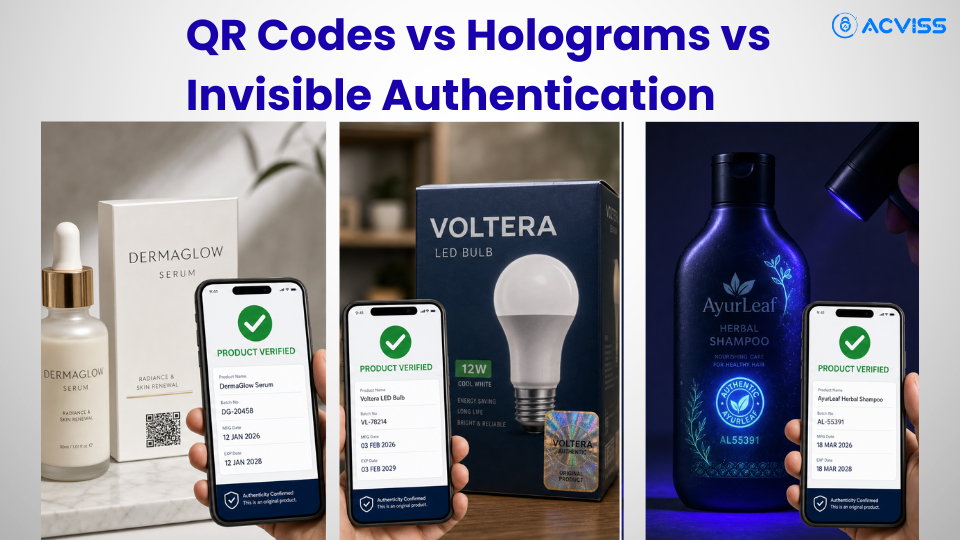
QR Code vs Hologram Label vs Invisible Layer For Your Brand
In this article Overview: Three Authentication Methods Side by Side QR Code Authentication: Strengths, Weaknesses, and When to Use It
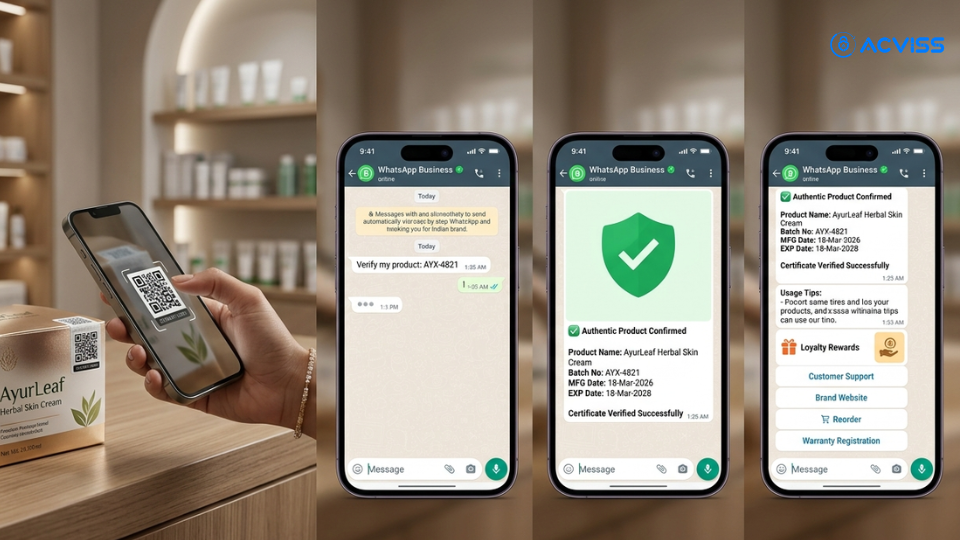
How WhatsApp Product Authentication Help Brands Fight Fakes
In this article Why WhatsApp Changes Everything for Product Authentication in India How WhatsApp-Based Authentication Works: Step by Step Wh