
- Why WhatsApp Changes Everything for Product Authentication in India
- How WhatsApp-Based Authentication Works: Step by Step
- What Your Brand Gets from WhatsApp Authentication
- WhatsApp Authentication vs App-Based Authentication
- WhatsApp Authentication vs SMS Authentication
- Industries Using WhatsApp-Based Authentication in India
- How Certify by Acviss Implements WhatsApp Authentication
- Frequently Asked Questions
- See How Certify’s WhatsApp Authentication Works for Your Product Category
How WhatsApp Product Authentication Help Brands Fight Fakes
 Mithileshkumar R NaikMay 19, 202611 min read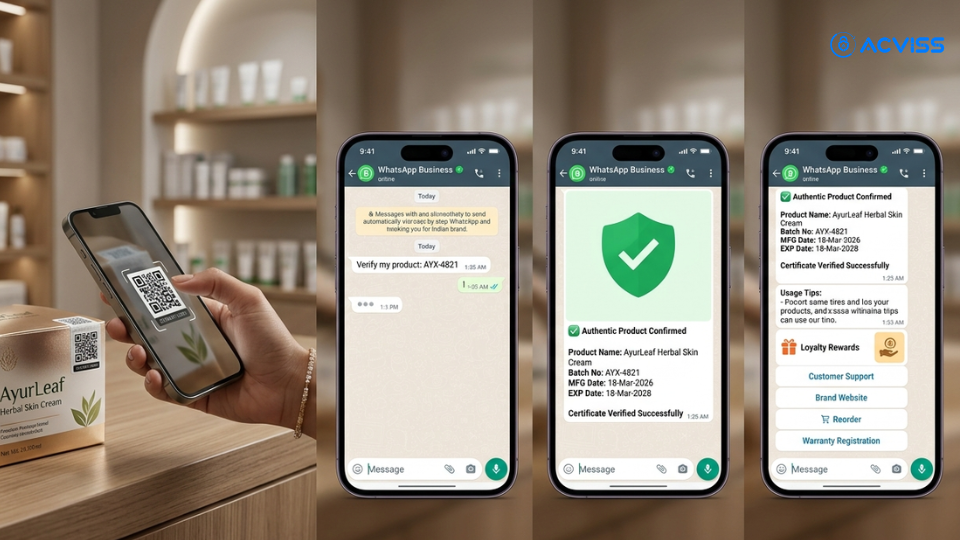
- App-based authentication has a real adoption problem: most consumers won’t download a dedicated app just to check one product.
- WhatsApp-based verification removes that friction, since almost every consumer already has the app installed.
- A quick scan-and-message flow lowers the barrier enough that ordinary customers, not just brand-conscious ones, actually verify products.
- Higher verification rates give brands better real-world data on where counterfeit scans are concentrated geographically.
This is a form of covert authentication made consumer-facing through a channel people already use daily — the kind of gap left open when, as our guide on why ERP isn’t enough for manufacturing traceability explains, ERP stops at the factory wall.

You have a product authentication system. It works. The QR code on your pack links to a verification page. The problem is that your consumers are not using it.
This is not a hypothetical concern. Industry data consistently shows that fewer than 5% of consumers download standalone brand verification apps, even when brands invest in marketing them. The friction of finding the app, downloading it, creating an account, and then remembering to use it every time they buy your product is simply too high for most shoppers. Authentication systems that depend on app downloads are, in practice, mostly invisible to your consumers.
India’s counterfeit problem does not get solved by a feature that 95% of consumers never activate. For brand managers who have already thought carefully about this problem, the question is not whether to authenticate your product, it is which mechanism your consumers will actually use. That is where WhatsApp changes the equation entirely.
Why WhatsApp Changes Everything for Product Authentication in India
India has more than 500 million active WhatsApp users, making it one of the largest WhatsApp markets in the world, according to widely cited figures from Meta. More importantly, WhatsApp is not a feature that users have to discover or remember. It is open on most Indian consumers’ phones for most of the day. It is how people communicate with family, receive updates from schools, coordinate with local businesses, and stay in touch with colleagues. It is, for hundreds of millions of Indians, the primary internet application.
This behavioral reality is the foundation of WhatsApp-based product authentication. When your authentication mechanism sits inside an app your consumer is already using every day, the friction of verification drops to near zero. There is nothing to download. There is no account to create. There is no password to remember. The consumer scans a code, a WhatsApp chat opens automatically, and within seconds they have a verification result.
For brand managers evaluating authentication options, this is not a marginal improvement in consumer convenience. It is the difference between an authentication system that sits dormant on your packaging and one that actually gets used, generates data, and creates a channel between your brand and the consumers buying your product.
How WhatsApp-Based Authentication Works: Step by Step

The consumer journey in WhatsApp-based authentication is deliberately short. Here is how it works in practice.
Step 1: Consumer scans the QR code
The consumer uses their phone camera or any QR scanner to scan the unique QR code printed on your product. No app installation required. Every smartphone in India with a camera can read a QR code through the default camera application.
Step 2: WhatsApp opens automatically
The QR code contains an encoded link that opens a WhatsApp chat directly, pre-loaded with the product’s unique authentication identifier. The consumer does not type anything. WhatsApp opens and the identifier is already in the message field.
Step 3: Consumer sends the message
The consumer taps send. This takes approximately one second. The message goes to the brand’s authenticated WhatsApp business number.
Step 4: Instant authenticity certificate
The system checks the unique code against the brand’s product database in real time. Within seconds, the consumer receives a reply in WhatsApp confirming the product is genuine. The reply includes the product name, batch information the brand chooses to share, and confirmation of authenticity. If the code has already been scanned multiple times, indicating a counterfeit has been made using a copied code, the system flags the scan as suspicious.
Step 5: Product information and brand engagement
Because this is a two-way WhatsApp channel, brands can use the same interaction to share warranty registration links, usage information, loyalty program entry, or any other consumer engagement touchpoint. Authentication becomes the start of a relationship, not just a one-time check.
What Your Brand Gets from WhatsApp Authentication
Consumer-side simplicity is only part of the story. The brand-side data generated by WhatsApp authentication gives your team capabilities that no traditional anti-counterfeiting method provides.
Real-time scan location data
Every scan is timestamped and geolocated. Your brand dashboard shows exactly where your products are being verified: which cities, which districts, which retail clusters. If you ship products to a distributor in Pune and scans start appearing in Hyderabad, you have a grey market or counterfeit signal that your field team can investigate immediately.
Fake scan detection and alerts
Each product code is unique and should be scanned once. When a code is scanned multiple times, which happens when counterfeiters replicate your code on fake products, the system detects the anomaly. Your brand team receives an alert. The consumer who triggered the nth scan receives a warning that the product may not be genuine. Both sides are informed simultaneously.
Geographic counterfeit hotspot mapping
Over time, scan data builds into a geographic picture of where your counterfeit risk is concentrated. If a specific district in UP or a particular market in Delhi generates a disproportionate share of suspicious scans, that is actionable intelligence. Your brand protection team can work with field teams or enforcement agencies in those specific locations rather than running broad, expensive investigations.
Consumer behaviour analytics
Scan rates by SKU, by region, by time of day, and by channel give you a continuous read on where your authenticated products are reaching consumers and which product lines are generating the most verification activity. This data has value beyond brand protection, informing distribution decisions and market development priorities.

See Certify in action
See how Certify lets any customer verify a product over WhatsApp, no app required.
Explore CertifyWhatsApp Authentication vs App-Based Authentication
| Factor | WhatsApp Authentication | Dedicated App Authentication |
|---|---|---|
| Install friction | None. WhatsApp is already installed on the consumer’s phone. | High. Consumer must find, download, and install a separate application. |
| Consumer adoption rate | Higher. No new behaviour required from consumers who already use WhatsApp daily. | Low. Industry data suggests fewer than 5% of consumers download standalone verification apps. |
| Geographic reach in India | Wide. WhatsApp penetration reaches across Tier 1, 2, and 3 cities and rural markets. | Limited. App downloads correlate with higher smartphone sophistication and data confidence. |
| Scan analytics | Full location, timestamp, and frequency data per scan. | Full analytics, but only for the minority of consumers who complete the download. |
| Brand communication channel | Two-way. After verification, the consumer is already in a WhatsApp chat. Warranty, loyalty, and product information can follow immediately. | Limited to app interface. Requires consumer to remain engaged with the app beyond verification. |
| Maintenance overhead | Platform maintained by Meta. Brand manages the business account and messaging logic. | Brand maintains and updates the app across operating system versions and device types. |
WhatsApp Authentication vs SMS Authentication
SMS-based authentication has been used by some brands as a lower-friction alternative to app downloads. The consumer texts a code to a shortcode number and receives a reply confirming authenticity. On the surface, this seems comparable to WhatsApp. In practice, there are meaningful differences.
The most significant is SMS spoofing risk. SMS is a relatively open channel, and the technology to send fake SMS messages that mimic legitimate numbers is widely available. A counterfeiter who knows your SMS authentication shortcode and message format can set up a parallel system that responds to codes on fake products with convincing-looking authenticity confirmations. Consumers receive a legitimate-looking SMS reply and believe the product is genuine.
WhatsApp authentication operates on verified business accounts. Meta’s WhatsApp Business API requires brand verification, and the authentication is tied to a verified business profile with a green checkmark that consumers can see. The same SMS spoofing infrastructure cannot replicate a verified WhatsApp business interaction. For consumers, this distinction matters: a WhatsApp reply from a verified business account is a meaningfully different trust signal than an SMS from a shortcode.
WhatsApp also gives brands richer response formats. An SMS can return a text string. A WhatsApp response can include product images, formatted text, links, and follow-up messages, creating a more complete authentication and brand communication experience.
Industries Using WhatsApp-Based Authentication in India

FMCG
Consumer packaged goods brands face high counterfeit risk and high sales velocity, which means authentication needs to be fast and require minimal consumer effort. WhatsApp authentication fits FMCG because it adds zero friction at point of sale and works on packaging of any size, from a single-serve pouch to a bulk pack.
Pharmaceuticals
The stakes in pharma authentication are highest: a consumer who cannot verify a medicine’s authenticity is at genuine health risk. WhatsApp authentication gives Indian pharmaceutical companies a consumer-facing verification channel that works for the semi-literate consumer in a Tier 3 market and the digitally confident consumer in a metro alike. The WhatsApp interaction can be made available in regional languages without any additional development complexity.
Agrochemicals
Farmers purchasing pesticides or seeds are often in rural settings with limited internet access beyond WhatsApp. Authentication through a WhatsApp scan works in low-bandwidth environments and reaches farmers who would never download a standalone verification app. For brands like Corteva Agriscience, which operates in India’s agricultural market, putting authentication on the channel farmers already use is a meaningful step toward protecting both brand and farmer livelihood.
Consumer Electronics and Accessories
High-value electronics accessories, spare parts, and components carry strong counterfeit incentives. WhatsApp authentication gives retailers and end consumers a quick, memorable verification step that does not require dedicated scanning hardware at the point of sale.
How Certify by Acviss Implements WhatsApp Authentication
Certify by Acviss is built around a patented non-clonable 2D code that is unique to each individual product unit. Unlike standard QR codes that can be photocopied and placed on fake products, the code generated by Certify cannot be replicated because the uniqueness is encoded at a level that copy-and-print cannot reproduce. This is a foundational difference from most QR-based systems: the QR code itself is part of the security architecture, not just a link to a database.
When a consumer scans a Certify code, WhatsApp opens automatically with the product identifier pre-loaded. The consumer sends it, and within seconds the Certify system returns a verification result through the WhatsApp chat. No app. No login. No wait. On the brand side, every scan is logged with location, timestamp, and device data in the Certify dashboard. Brands can monitor scan patterns in real time, receive alerts on anomalous scan activity, and map counterfeit hotspots geographically without waiting for field reports or consumer complaints. Certify requires no changes to your existing packaging line beyond adding the printed code. You can learn more at acviss.com/certify-by-acviss.
Frequently Asked Questions
Is WhatsApp authentication secure enough for pharmaceutical products?
Yes, when implemented with a non-clonable unique code at the product level. The WhatsApp channel itself is end-to-end encrypted. The security of the system ultimately depends on how hard the underlying product code is to replicate. A cryptographically unique, non-clonable code like the one used in Certify provides a much higher security baseline than a standard QR code, making the WhatsApp delivery channel appropriate even for high-stakes pharma applications.
Can a counterfeiter fake a WhatsApp response?
A counterfeiter cannot replicate a response from a brand’s verified WhatsApp Business account without access to that account. What counterfeiters can do with simpler QR-based systems is copy the QR code itself and place it on fake products; the authentic QR code then returns an authentic-looking response because the database thinks the real product is being scanned. Certify’s non-clonable code addresses this at the source: the code itself cannot be copied, so a fake product carrying a copied code will not return a valid authentication response.
What data does my brand get from each consumer scan?
Each scan returns location data (city-level or more granular depending on the consumer’s device settings), timestamp, product identifier matched against the specific unit scanned, and scan frequency for that specific code. Brands can see aggregate scan patterns across their entire product range through the Certify dashboard.
Does WhatsApp authentication work in areas with poor internet connectivity?
WhatsApp is designed to function on low-bandwidth connections, which is a significant reason for its penetration in rural India. The authentication transaction is small in data terms, and WhatsApp’s architecture is optimized for intermittent connectivity. In areas where data connectivity is extremely limited, the authentication may be delayed, but it will complete once the device reconnects.
See How Certify’s WhatsApp Authentication Works for Your Product Category
Product authentication only protects your brand if consumers actually use it. WhatsApp removes every barrier that has historically kept authentication adoption low: no app to download, no new platform to learn, no friction at the point of purchase. For Indian brands managing counterfeit risk across Tier 1 to Tier 3 markets, it is the most practical consumer-facing authentication mechanism available today.
See how Certify’s WhatsApp authentication works for your product category. Book a demo.

Verification your customers will actually use
Book a free demo and see how Certify’s WhatsApp verification fights fakes at scale.
Book a Free DemoRelated reading

How Kitply Doubled Sales Implementing Product Authentication
Kitply Industries is one of the most recognized names in Indian plywood. Decades of market presence, a
QR Code vs Hologram Label vs Invisible Layer For Your Brand
Most brands choose their anti-counterfeiting method the wrong way. They pick what their largest competitor