
- Question 1: Does Verification Work Without a Consumer App Download?
- Question 2: Is the Authentication Technology Non-Clonable, or Can a Sophisticated Counterfeiter Copy It?
- Question 3: Does the Solution Cover Both Physical Product Authentication AND Online Brand Enforcement, or Only One?
- Question 4: What Data Do You Get When Someone Scans?
- Question 5: How Long Does Deployment Take, and What Changes in Our Packaging Workflow?
- Question 6: Can the Solution Integrate With Our ERP: SAP, Dynamics, or Others?
- Question 7: How Does the Vendor Handle a Counterfeit Hotspot Alert? What Is the Response Process?
- Question 8: What Regulatory Compliance Does the Solution Support?
- Question 9: What Does the Pricing Model Look Like: Per Label, Per Scan, or Flat Fee?
- Question 10: Can You Show Us a Case Study From Our Industry With Specific Metrics?
- A Note on Vendors Who Deflect These Questions
- Ready to Evaluate Acviss?
10 Questions to Ask Before Choosing an Anti-Counterfeit Solution
 Mithileshkumar R NaikMay 19, 202612 min read
- Choosing an anti-counterfeit vendor means asking about non-clonability, not just whether a solution has a QR code or hologram.
- Pricing models vary widely (per label, per scan, or flat fee), so clarify total cost before committing to a scale-up.
- ERP integration (SAP, Dynamics, or others) determines how much manual work your team does after the vendor is onboarded.
- Vendor support quality and implementation timeline matter as much as the technology itself for a smooth rollout.
Start by anchoring these questions against a clear definition of anti-counterfeiting so vendor claims can be compared on the same terms, including how a vendor protects your supply chain specifically, covered in our piece on five ways anti-counterfeit technology protects your supply chain.
 The OECD/EUIPO tracks the scale of global trade in counterfeit and pirated goods.
Most brand managers reach the vendor shortlist stage after months of research. They have seen the demos, read the brochures, and sat through the pitch decks. And yet, a significant number of them end up deploying a solution that solves only a fraction of their actual problem.
The buying process for anti-counterfeiting technology is broken in a specific way: buyers ask the wrong questions. They focus on price, turnaround time, and the number of logos on the client list. What they do not ask is whether the solution will actually work in the real-world conditions their products face, whether their consumers will use it, or whether it will hold up against a determined counterfeiter.
This post gives you the 10 questions that separate good vendors from great ones. If you are evaluating two or three options right now, take these into your next call. The answers will tell you more than any brochure.
Question 1: Does Verification Work Without a Consumer App Download?
This is the most important adoption question you can ask, and it is the one most brands skip entirely.
Here is the problem. You print 10 million authentication labels. A contractor in Bhopal, a distributor in Coimbatore, or a homeowner in Patna picks up your product and wants to verify it. If the verification process requires them to download a dedicated app, most of them will not bother. App fatigue is real. India has some of the highest smartphone penetration in the world, but that does not mean consumers will install a new application every time they buy a product.
The smarter approach is verification through channels people already use every day. Scanning a code that opens directly in a browser, or sending a message on WhatsApp, requires zero installation. The friction is close to zero. Adoption rates follow accordingly.
Ask your vendor: How does verification work from the consumer side? If the answer involves an app download as the primary path, that is a significant adoption risk. The right answer is a no-app flow, either web-based or WhatsApp-based, with the app as an optional alternative, not the default.
Acviss Certify uses a WhatsApp and web verification flow so that any consumer, distributor, or inspector can verify a product on the spot, on any device, without installing anything.
Question 2: Is the Authentication Technology Non-Clonable, or Can a Sophisticated Counterfeiter Copy It?
Standard QR codes and barcodes are trivially easy to copy. A counterfeiter prints your packaging, scans your code, and prints the same code on 50,000 fake units. The consumer scans the fake and gets a “verified authentic” response. This is not a theoretical risk. It happens regularly in markets with established counterfeit operations.
The question to ask is: What stops a sophisticated counterfeiter from simply duplicating your authentication label?
A credible vendor will be able to explain the physical or cryptographic properties that make duplication either impossible or commercially unviable. Patents matter here. A solution backed by patents on the underlying technology signals that the non-clonability claim has been independently evaluated.
Acviss Certify uses a patented non-clonable 2D code. The technology is designed so that reproducing the code does not produce a functional replica. This is one of the three patents Acviss holds on its authentication technology.
If a vendor cannot clearly answer what happens when someone tries to clone their label, or if they deflect by saying “our codes are encrypted” without explaining why encryption alone is insufficient against physical duplication, treat that as a serious gap.
Question 3: Does the Solution Cover Both Physical Product Authentication AND Online Brand Enforcement, or Only One?

Counterfeiting in 2026 operates on two fronts simultaneously. Fake physical products move through trade channels, wholesale markets, and unauthorized distributors. At the same time, fake listings appear on Amazon, Flipkart, Meesho, and hundreds of smaller marketplaces, often undercutting your genuine price and damaging your brand’s digital presence. That online-side risk is the specific focus of our piece on how to protect your ecommerce brand from counterfeit.
Many solutions address one front and ignore the other. A physical authentication label with no online monitoring means you are unaware of the scale of online counterfeiting against your brand. An online monitoring tool with no physical verification means you have no way to stop fakes at the trade or consumer level.
Ask your vendor: Does your solution cover both physical authentication and online marketplace monitoring? How does the intelligence from each feed into the other?
The best vendors can tell you not just that they do both, but how they connect the two. A spike in online fake listings in a particular city, combined with scan data showing a high rate of suspicious verification attempts in the same geography, gives your enforcement team an actionable lead.
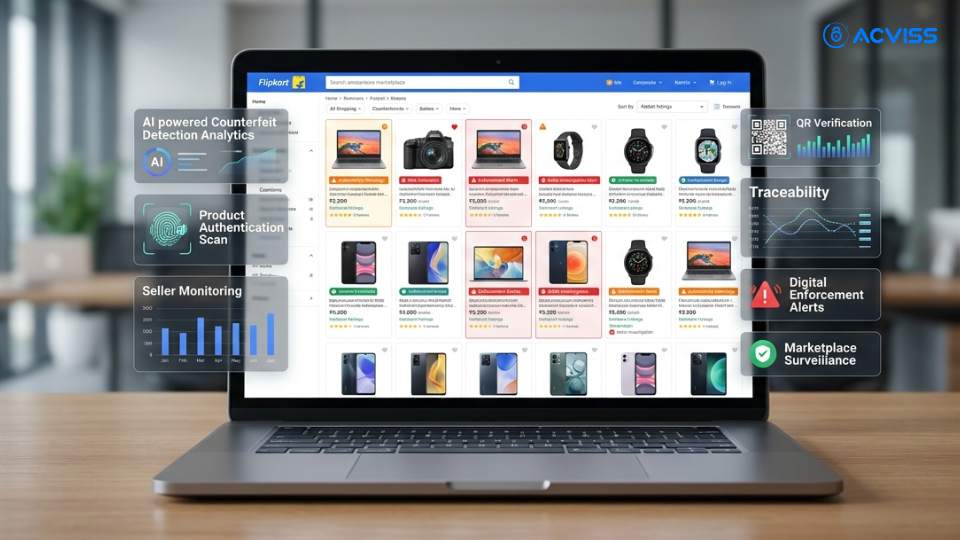
Acviss offers Certify for physical product authentication and Truviss for online brand protection across 5,000+ marketplaces. Both products are available together, giving you a unified view of the counterfeit activity against your brand.
Question 4: What Data Do You Get When Someone Scans?
Authentication is not just a consumer service. It is an intelligence system. Every scan is a data point. The question is whether your vendor surfaces that data in a way that your team can actually act on.
Ask specifically: What data is captured at the point of scan, and how is it presented to my team?
The minimum you should expect is: scan timestamp, approximate geolocation, device type, and scan count per unit (so you can flag units that have been scanned an unusual number of times, which often signals a fake label being reused). What separates good platforms from basic ones is the analytics layer on top: counterfeit hotspot mapping, alert thresholds, trend analysis, and the ability to drill down by SKU, region, or time period.
If a vendor shows you a dashboard with a total scan count and a download button, that is not intelligence. You want to see something that tells your enforcement team where to go and what to do next.
Geolocation data from counterfeit-flagged scans is particularly valuable. If 800 failed authentications come from one district in a two-week period, that is an enforcement signal, not just a statistic.

See Certify in action
See how Certify answers the hard questions before you commit to a vendor.
Explore CertifyQuestion 5: How Long Does Deployment Take, and What Changes in Our Packaging Workflow?
Many brand managers underestimate implementation complexity and end up with a solution that disrupts their production line, delays their launch, or requires packaging redesign that takes six months.
Ask: What does our packaging workflow look like during and after deployment? What changes on our side, and what is the timeline to first labels?
The honest answer will include: integration with your current label printing or packaging process, any artwork changes required, timeline for onboarding your products and SKUs into the verification system, and what training or process changes your production team needs.
Red flags here include vague timelines (“it depends on your setup”), requirements for expensive specialized printing equipment, or significant packaging artwork changes for all SKUs as a prerequisite to going live.
The right answer is a phased approach: start with one product line or SKU family, prove the process, then scale. A vendor who insists on deploying everything at once is optimizing for contract value, not your success.
Question 6: Can the Solution Integrate With Our ERP: SAP, Dynamics, or Others?
If your production and supply chain run on SAP or Microsoft Dynamics, your authentication system needs to work alongside them. A standalone tool that creates a parallel data silo adds operational overhead and limits how useful the data actually is.
Ask: What ERP integrations do you support, and how does the integration work in practice?
The key word is “in practice.” Many vendors will say “we support SAP” and mean they have a flat-file export that someone can manually import once a week. That is not an integration. A real integration means product master data flows between systems, scan events trigger workflows in your ERP, and recall or alert data can propagate automatically.
Acviss Origin, the supply chain traceability product, supports SAP and Microsoft Dynamics integration as part of the standard deployment for enterprise customers. If your operations team is evaluating traceability as part of the same project, this question applies directly to that workstream too.
Question 7: How Does the Vendor Handle a Counterfeit Hotspot Alert? What Is the Response Process?

You will discover counterfeit activity. The question is what happens next. Many vendors treat alert delivery as the end of their job. You get a notification. What you do with it is your problem.
Ask: When a counterfeit hotspot is identified, what is your process? Do you support enforcement action, or is that handed off entirely to us?
A stronger answer includes: a defined escalation process, support for coordinating with your legal or field team, documentation capture for enforcement purposes, and historical data that can support a complaint to a marketplace or a regulator.
Online counterfeiting in particular requires a response workflow. A Truviss-type solution that monitors 5,000+ marketplaces should have a process for flagging listings, generating takedown evidence, and submitting removal requests, not just emailing you a screenshot of a fake listing.
If a vendor has never been asked this question before, or if their answer is “we surface the alert and then it is in your hands,” that is an accurate reflection of how much actual enforcement support you will get.
Question 8: What Regulatory Compliance Does the Solution Support?
Depending on your industry and export markets, your authentication or traceability system may need to satisfy specific regulatory frameworks. Asking this question upfront saves you from discovering a compliance gap after you have already deployed.
Relevant examples include:
- CDSCO requirements for pharmaceutical traceability in India, including serialization and labelling requirements for scheduled drugs and export shipments
- EU Deforestation Regulation (EUDR) for agricultural commodities sold into EU markets, which requires supply chain traceability documentation to prove non-deforestation compliance
- DSCSA (Drug Supply Chain Security Act) for Indian pharma companies exporting to the United States
- EU Falsified Medicines Directive (FMD) for pharmaceutical exports to Europe
Ask: Which regulatory frameworks does your solution currently support, and do you have customers who have passed compliance audits using your system?
The answer should be specific. “We are compliant with all relevant regulations” is not an answer. A vendor who can name the specific modules, reporting formats, or data structures that satisfy a given regulation, and can point to a customer who has used that functionality in a real audit, is a vendor who actually understands the compliance landscape.
Question 9: What Does the Pricing Model Look Like: Per Label, Per Scan, or Flat Fee?
Pricing models in anti-counterfeiting vary widely, and the structure matters as much as the number. A per-scan pricing model can work well at low volumes and create budget predictability problems at scale. A per-label model is easier to forecast but may penalize you for high-volume SKUs. A flat fee model requires careful negotiation on what is included and what triggers an overage charge.
Ask: What is your pricing model, and how does our bill change as we scale from one product line to five, or from 100,000 units to 5 million?
Walk through specific scenarios with numbers your team can actually model. Ask what happens if scan volume doubles unexpectedly, for example during a product recall or a marketing campaign that drives verification traffic. Ask whether onboarding new SKUs or product lines carries an additional cost.
Also ask whether the online monitoring component (if applicable) is included or separately priced, and whether enforcement actions like marketplace takedowns carry per-action fees.
Transparency at this stage is a proxy for how the commercial relationship will work once you are a customer. Vendors who are vague about pricing before the contract are not going to become clearer after you sign.
Question 10: Can You Show Us a Case Study From Our Industry With Specific Metrics?
Every vendor has a list of logos. What you need is evidence of outcomes in a context that resembles your situation.
Ask: Do you have a customer in our industry who has published results, and can you connect us with a reference?
The answer you are looking for is a case study that names the customer, describes the problem, and gives specific before-and-after metrics. Not “a leading FMCG brand saw improved results.” Names, industries, and numbers.
Acviss works with brands including Kitply Industries, Corteva Agriscience, ITC, Pigeon, and TATA. Case studies are available at acviss.com/case-studies. Rajshekhar, Sales Head at Kitply, noted that production and sales increased following their Acviss deployment, a result that came from restoring distributor and contractor confidence in genuine product authentication.
If a vendor cannot provide a named customer with verifiable results, that is worth noting. It may mean their customer base is too new to have results, their results are not impressive enough to publish, or their customers are unwilling to be referenced. All three possibilities are informative.
A Note on Vendors Who Deflect These Questions
You will find that some vendors answer every question and some vendors deflect. The deflection patterns are worth recognizing:
- “That is very implementation-specific.” Sometimes true, usually a way of avoiding a direct answer about a known weakness.
- “Our technology is proprietary so we cannot go into detail.” Fair for some specifics, not fair as a reason to avoid explaining how their non-clonability claim actually works.
- “We have many enterprise customers who trust us.” Not a substitute for evidence of outcomes.
- “We can connect you with our team to discuss further.” A follow-up meeting is fine. Using it to end every difficult question is a pattern.
- “We are compliant with all applicable regulations.” Ask which ones by name.
A vendor who answers all 10 of these questions directly, with evidence, is a vendor who has thought carefully about what you actually need. A vendor who deflects more than two or three of them is signaling that there are gaps in the solution you have not found yet.
Use these questions as a rubric, not a gotcha. The goal is not to catch vendors out. It is to find the one that will still be the right fit 18 months after go-live, when the initial implementation energy has passed and you need a partner, not a product.
Ready to Evaluate Acviss?
We answer all 10 of these questions upfront, with specific evidence, on the first call. No deflections, no “let me get back to you on that.” If you are in the process of evaluating anti-counterfeiting vendors, we would like to be part of that conversation.
Schedule a call with our team and bring these questions with you. We will have the answers ready.

Ask the right questions before you choose
Book a free demo and see how Certify answers the questions that matter most.
Book a Free DemoRelated reading

The Real Scale of India’s Counterfeit Market in 2026
India-Counterfeiting-Statistics-2026-The-Scale-of-Fake-Products-Across-Every-Major-Industry
7 Best Anti-Counterfeit Software Solutions for Indian Brands 2026
In this article How to Compare Anti-Counterfeiting Solutions: Key Criteria Acviss (Certify + Truviss + Origin) Ennoventure NeuroTags VCQRU R