

- Print and Digital Are Now One Security System
- What a Secure Document Actually Has to Do
- How AI Changes Both Sides of the Equation
- Why a Duplicate Doesn’t Verify
- One Identity, Four Depths of Verification
- Where the Identity Lives After the Press
- What This Asks of Each Participant
- A Government Certificate, In Production
- The Same Argument, Made to Indonesia’s Security Printers
 Arun KrishnanSep 25, 20269 min read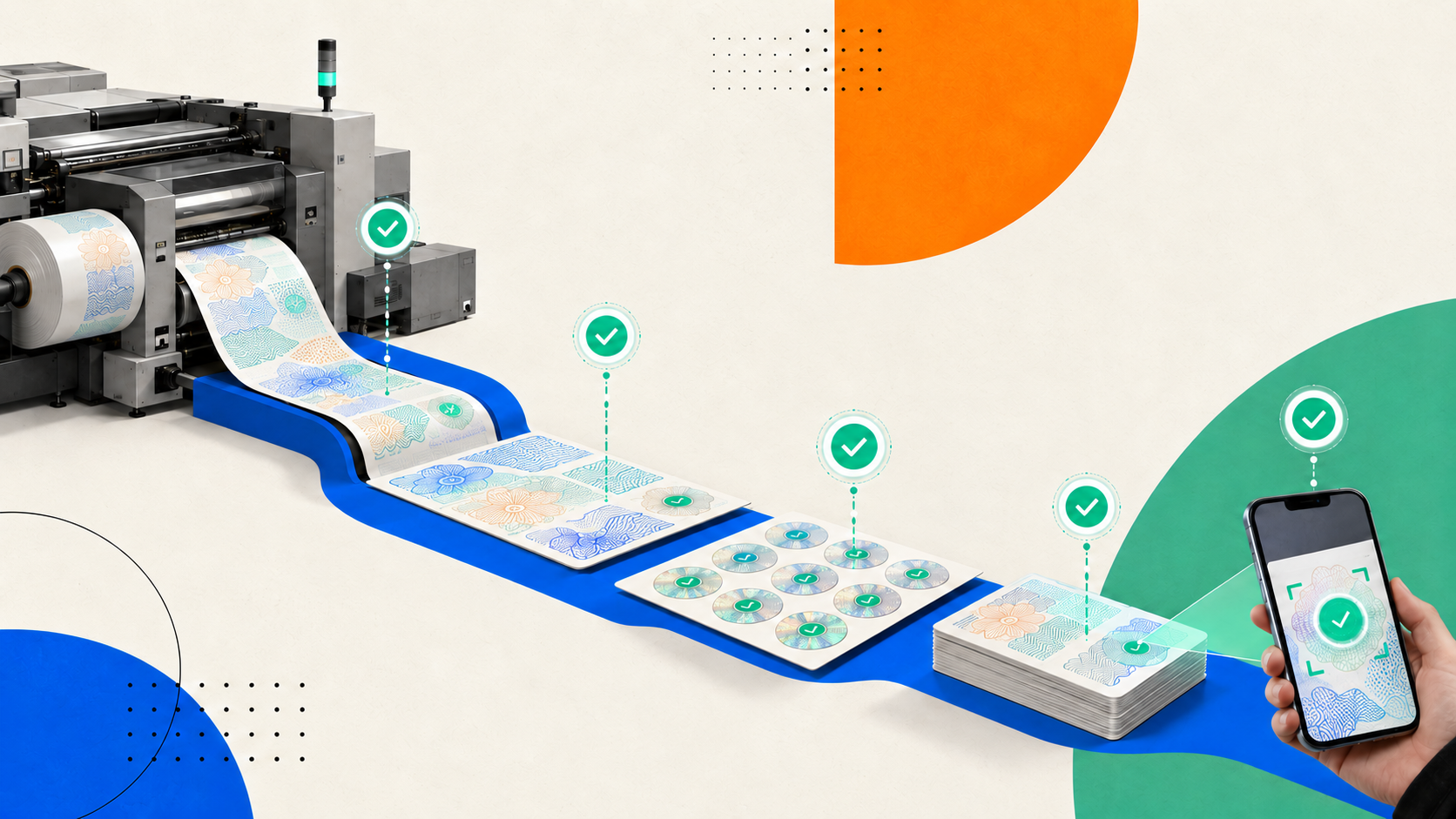
For most of its history, a security document proved itself the same way: hold it up, and the print told you whether it was real. Hidden patterns, microtext, optically variable ink. The harder these were to reproduce, the safer the document was assumed to be.
That assumption is breaking down. A printed document today is created, issued, verified and managed through digital systems at every stage, and the two sides are no longer designed or audited separately. A document that proves itself on sight increasingly has to prove itself on a server too.
- Physical print security and digital verification have become one system, not two separate supply chains.
- AI has made reproduction difficulty alone a weaker defence, so documents increasingly need a verifiable digital identity behind the print, tracked through its full lifecycle.
Print and Digital Are Now One Security System
The physical document still carries trust. Its substrate, inks and optical effects, and any personalisation bound to the holder, remain what a person can check by eye. What has changed sits downstream of the print run: issuance records, authentication requests, and a status and lifecycle history that follows the document long after it leaves the press.
AI did not create this shift. It raised the cost of ignoring it.
In 2024, digital forgery overtook physical counterfeiting for the first time, accounting for 57% of document fraud, and national identity documents alone absorbed 40.8% of all attacks recorded that year. Counterfeit goods more broadly move through global trade at a value the OECD placed at USD 467 billion, equal to 2.3% of world imports, in its most recent mapping of global fakes. Generative tools now produce synthetic signatures, portraits and layouts fast enough to make visual inspection an incomplete control on its own.
What a Secure Document Actually Has to Do
Resisting reproduction is no longer the whole job. A document built to survive contact with an AI-assisted forger has to do four things, in order.
1. Protect
Make the document difficult to reproduce or alter, through overt, covert and forensic print security.
2. Identify
Give the document a unique, verifiable identity, so one document maps to exactly one record.
3. Verify
Prove authenticity at the point the document is presented, combining the physical and digital identity.
4. Trust
Know whether that identity is still legitimate. Issuance, status and verification history decide this, not the print alone.
The goal was never just a document that is harder to copy. It is a document whose authenticity can be proved, on demand, at any point in its life.
| Layer | What it checks |
|---|---|
| Overt | Visible and interpretable by eye, no equipment needed |
| Covert | Needs a known method or device to inspect |
| Forensic | Material characteristics, examined in a laboratory |
| Digital | A unique identity, checked against the issuance record |
| Intelligence | Verification activity, checked for duplicates and anomalies |
How AI Changes Both Sides of the Equation
AI cuts both ways in this system. The same generative and pattern-recognition techniques that make forgery easier also make inspection sharper, and the two are advancing together, not one after the other.
On the threat side, generative tools create synthetic images, signatures and portraits convincing enough to pass a casual check, alter variable data and layouts faster than a human editor could, and let a single operator produce and adapt fraud attempts at a scale manual review cannot absorb. Convincing supporting material, a matching employment letter or photo ID, can be built around a fraudulent document to survive a second look.
On the defence side, the same class of technique inspects for visual inconsistencies and production anomalies a reviewer would miss, analyses security features beyond a manual comparison, flags verification or usage behaviour that does not match how a document class is normally used, and connects signals across large volumes of events for an investigation.
AI does not replace physical security. It decides whether the document, its identity and the behaviour around it are consistent with each other.
Why a Duplicate Doesn’t Verify
Axion Label is Acviss’s security-label authentication solution. It answers a narrower question than whether a label is hard to copy: whether the specific unit in front of a verifier is the one that was actually issued.
The identity is built in five steps. An encoded identity and an AI-generated micro-texture design are generated together at the point of print, unique to that single label. The label is produced and applied within the existing packaging or document workflow. A reference for the label’s visual characteristics is registered against the certificate and the issuing authority. At verification, the embedded digital code is scanned, and the physical visual fingerprint is captured and compared against that registered reference. The two results are then evaluated together against configured thresholds, not read in isolation.
Photographing, scanning or reprinting a label alters its micro-texture pattern at pixel level, so a copied label fails the visual check even when the encoded data underneath still reads as valid. That is what makes the identity non-cloneable in a way the underlying artwork is not.
The artwork can be reproduced. The identity cannot.
See the five layers on one certificate
One physical document, five complementary security layers, produced in a single pass.
One Identity, Four Depths of Verification
The same identity does not need to say the same thing to everyone who checks it. What a scan returns depends on who is asking.
- Public or holder: a scan from any phone camera, through a browser or WhatsApp, returns authentic-or-not plus current status. No app to install.
- Field officer: a scan on an issued device returns status, issuance details and an alert when the identity looks abnormal.
- Control point: a scan at a fixed post checks the covert feature alongside the digital result, confirming physical and digital together before release.
- Forensic lab: examining the applied label as a material sample returns substrate and feature-level findings for a case file.
The public response stays deliberately thin. A consumer scanning their own certificate does not need, and should not receive, the same depth of information an investigator draws from the same identity.
Where the Identity Lives After the Press
Production security only covers the moment the label is made. What happens to the identity afterwards decides whether the document stays trustworthy for its full life.
- Production: the identity is generated and engraved under secure production control.
- Issuance: the identity is activated and bound to the holder, the authority and the issuance record.
- In use: every verification is recorded with time, place and channel, which is also what lets duplicate activity, failure clusters and abnormal usage patterns surface later.
- Status change: a single identity can be suspended, revoked or replaced without recalling the whole document class.
- Close out: expiry, renewal or retirement, with the history retained for audit.
This lifecycle closes two specific routes for abuse. An unissued identity that appears in the field can be refused outright, because activation happens at issuance and not at production, so stolen but unissued stock never becomes valid. A tamper-evident construction that destroys the label on removal closes the other route, which is lifting a genuine label off a genuine document and reapplying it to a different one.
Lifecycle control is what separates a secure document from a securely printed one. A genuine certificate can still be revoked. The paper does not change; only its digital status does.
The same identity and lifecycle model applies wherever an authority issues something that has to keep being true after it is printed: business registrations and trade licences, degrees and professional certificates, police clearances and compliance certificates, tax assessments and exemption orders. The certificate changes. The security architecture does not.
What This Asks of Each Participant
None of this works as a single supplier relationship. Four roles each hold a piece the others cannot substitute.
- Security printer: generates and applies the identity inside secure production, keeps print, engraving and tamper construction under existing controls, and hands over verified production data, not just finished stock.
- Issuing authority: activates identities at issuance rather than at production, owns the rules for status, suspension and revocation, and decides what each downstream role is allowed to see.
- Technology provider: integrates with the issuance systems already in use, exposes only the data a given transaction needs, and carries the certification and audit posture the authority requires.
- Inspection and enforcement: verifies in the field at the depth each role needs, feeds findings back so detection improves, and uses the identity’s history as case evidence.
The printer is the only participant present at the moment the identity is created. That position is difficult to replace, which is why production security remains the foundation everything else is built on.
A Government Certificate, In Production
One state police department in India now authenticates thousands of certificates a month using this architecture. Manual verification had been slow, and the gap left room for altered or duplicate documents to pass through.
Certificates were secured with a tamper-proof, AI-generated identity layer connected to real-time digital verification. The measurable change: faster certificate verification, immediate detection of duplicate or forged identities, a digital verification history for every certificate, and greater visibility for investigators and authorities reviewing cases after the fact.
The Same Argument, Made to Indonesia’s Security Printers
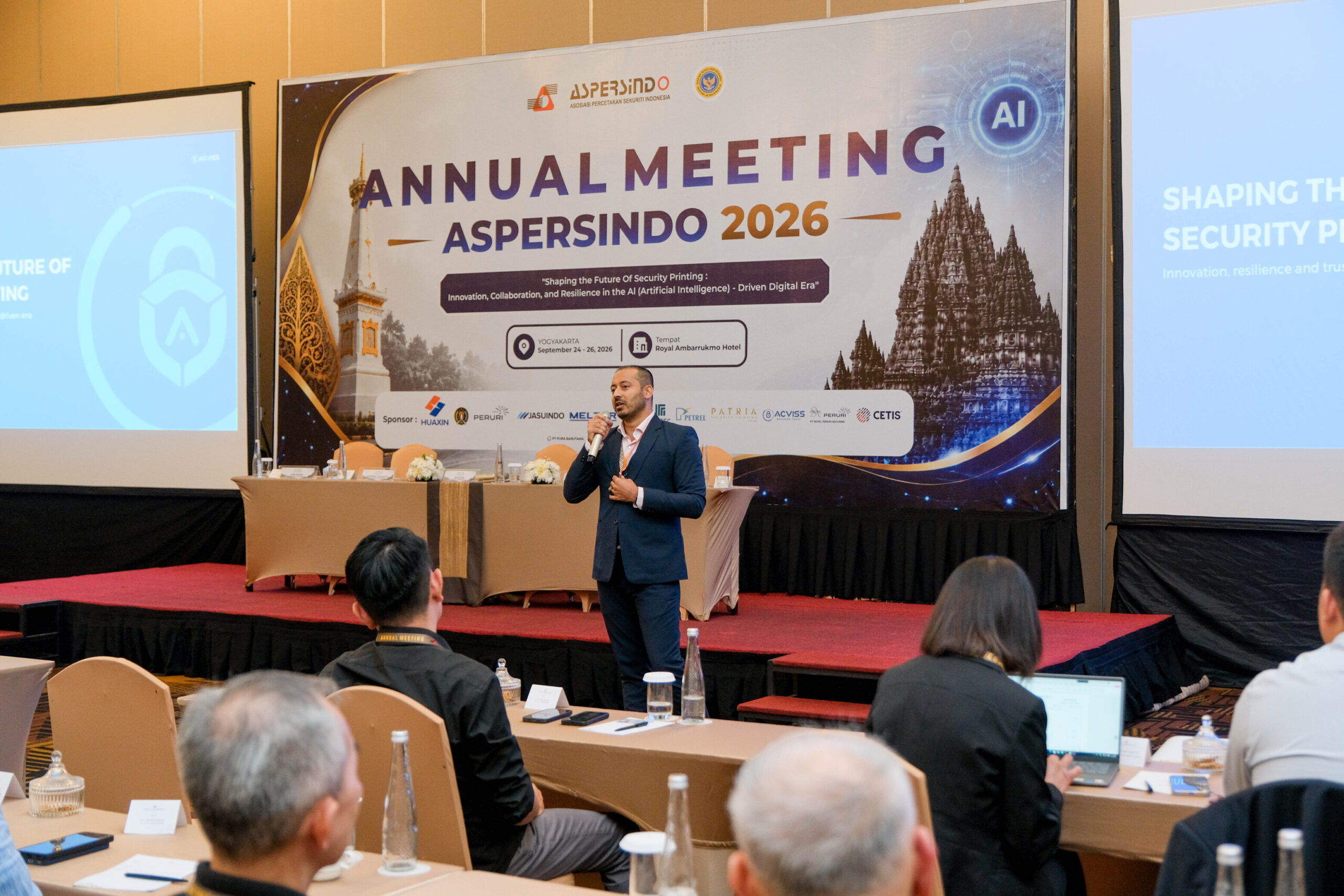
This is also what Vikas R Jain, Acviss’s Founder and CEO, put to Indonesia’s security printing industry at the ASPERSINDO Annual Meeting 2026 in Yogyakarta: print and digital security have stopped being separate supplier relationships and become one system, and the industry’s next competitive edge is not a harder pattern to copy but an identity that can be proved, checked and revoked long after the document leaves the press.

Security printing spent decades competing on how difficult a document was to copy. That competition is not over, but it is no longer sufficient by itself. The documents holding up best now pair print security with a digital identity that can be checked, revoked and audited long after the ink has dried.
Bring digital identity into your next print run
Talk to Acviss about adding a verifiable identity layer to the documents or labels you already produce.