Product Authentication: The Complete Guide (2026)
 Mithileshkumar R NaikAug 15, 20266 min read

- Product authentication verifies a physical product is genuine using a marker a counterfeiter can’t easily reproduce: QR codes, NFC chips, holograms, invisible layers, or RFID.
- Each technology trades off cost, who’s checking (customer vs warehouse), and how sophisticated the counterfeiting threat is, most brands combine more than one layer.
- Implementation runs through four steps: choosing the marker, integrating at the packaging line, setting up verification, and training the channel to check when in doubt.
- Certify supports multiple marker types under one verification backend, so the choice isn’t locked in as the product line or threat model changes.
A counterfeit product usually looks fine on the shelf. The packaging matches, the logo is correct, the price is close enough to pass. The only way a brand, a retailer, or a buyer can tell the difference is by checking something the counterfeiter could not easily copy. That check is what product authentication does.
This guide covers what product authentication actually means, the main technologies brands use to do it, how to choose between them, and what implementation looks like in practice.
What Product Authentication Means
Product authentication is the process of verifying that a physical product is genuine, using a marker, code, or feature embedded on or in the product or its packaging that a counterfeiter cannot easily reproduce. It is different from anti-counterfeiting in the broad sense, which also includes legal enforcement, marketplace takedowns, and supply chain controls. Authentication is specifically the point-of-verification layer: the moment a distributor, retailer, or end customer checks whether the unit in front of them is real.
According to the OECD/EUIPO joint report on trade in counterfeit and pirated goods, counterfeit trade affects nearly every product category, from pharmaceuticals to auto parts to FMCG. That breadth is why authentication technology has diversified: no single marker works for every product, price point, or environment.
The Main Authentication Technologies
QR Codes
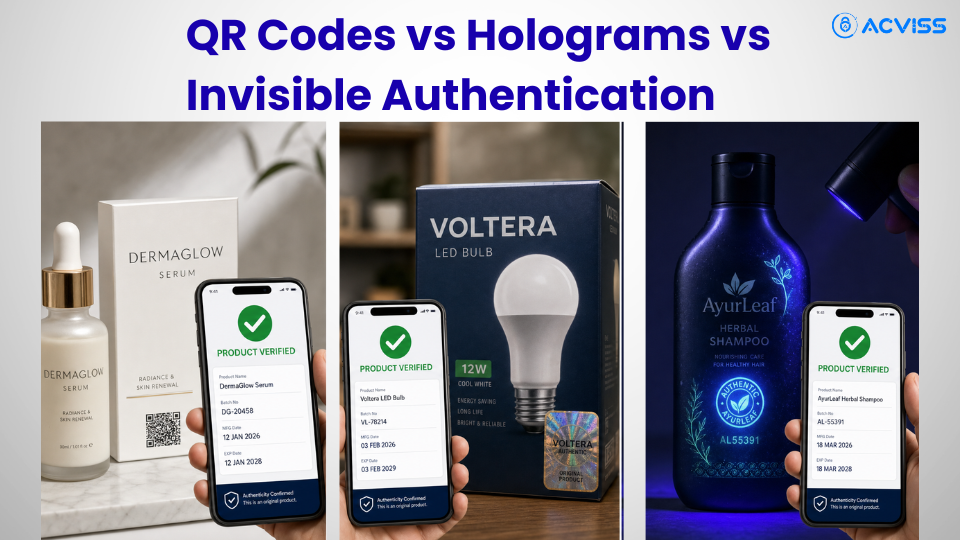
A unique QR code printed on packaging, scanned by the end customer’s phone, resolves to a verification page confirming the product’s authenticity and often its batch and manufacturing details. QR codes are cheap to implement and require no special hardware for the customer, which is why they are the most common entry point for brands starting authentication. The tradeoff: a copied QR code image still scans as valid unless the underlying system detects duplicate scans or scan-location anomalies.
NFC Tags and Chips
Near-field communication tags embed a small chip in the packaging or product that a smartphone can read by tapping it, without needing a camera or line of sight. NFC is harder to clone than a printed code because each chip carries a unique identifier that can be cryptographically verified. It costs more per unit than a QR code and needs NFC-capable customer devices, which is nearly universal on modern smartphones but still worth confirming for a given market.
Holograms
Holographic labels use optical effects (colour shift, 3D depth, micro-text) that are visually distinctive and difficult to replicate without specialised equipment. Holograms work well as a visible deterrent and a quick human check, especially in markets or retail environments where scanning isn’t practical. They don’t carry a digital record on their own, so brands often combine a hologram with a QR code or serial number for a verifiable audit trail, not just a visual cue.
Invisible and Covert Layers
Invisible ink, UV-reactive markers, and covert taggants are added to packaging or the product itself and are only visible under specific conditions (UV light, a proprietary reader, or forensic testing). Because counterfeiters don’t know the marker exists, it’s harder to target for replication than a visible feature. The tradeoff is that verification usually requires a special device or lab test, which limits it to enforcement and spot-check use rather than routine consumer verification.
RFID
Radio-frequency identification tags allow bulk, non-line-of-sight scanning, useful for high-volume supply chain checkpoints (warehouse intake, distribution centre exit) rather than individual consumer verification. RFID’s strength is throughput: a pallet can be scanned in seconds. Its role is usually supply chain visibility that feeds into a broader traceability system, alongside a separate consumer-facing marker.

See Certify in action
See how Certify supports QR, NFC, hologram, and covert authentication under one platform.
Explore CertifyHow to Choose Between Them
Most brands don’t pick one technology in isolation, they combine layers based on three questions:
- Who is checking, and how? If the primary check is an end customer with a phone, QR or NFC. If it’s a warehouse or enforcement team, RFID or covert markers make more sense.
- What’s the per-unit cost tolerance? QR codes add negligible cost per unit. NFC and holograms cost more. High-value products (pharma, electronics, spirits) can absorb higher per-unit authentication cost than low-margin FMCG.
- How sophisticated is the counterfeiting threat? A market with basic packaging counterfeits may be well served by a visible hologram. A market with organised counterfeiting operations replicating packaging in detail needs a marker that isn’t visually obvious, like a covert layer or a cryptographically verified NFC chip.
A useful starting comparison of the three most common consumer-facing options is in our breakdown of QR codes vs hologram labels vs invisible layers, which goes deeper on cost and implementation tradeoffs for each.

Implementation Basics
Rolling out product authentication typically involves four steps:
- Choose the marker(s) based on the criteria above, often starting with one primary consumer-facing marker and adding a second layer (covert or RFID) if the threat level justifies it.
- Integrate at the packaging line, which usually means working with existing packaging/printing vendors rather than replacing them, since most authentication markers can be added to existing label or carton production.
- Set up the verification system, the backend that confirms whether a scanned code, tapped chip, or scanned tag is genuine and hasn’t been duplicated or reported as counterfeit elsewhere.
- Train the channel, distributors and retailers, on how to check a product if a customer or channel partner raises a doubt, not just relying on the end customer scanning on their own.
Packaging line integration is often where authentication rollouts hit friction. Our post on common packaging line problems and how to fix them covers the practical issues (label misalignment, adhesive failure, print quality) that can undermine even a well-chosen authentication marker if the packaging line isn’t ready for it.
What This Looks Like in Practice
Kitply, a plywood manufacturer, implemented product authentication to give customers a simple way to verify genuine products before purchase, addressing counterfeit products that were undercutting genuine sales. The result was a measurable increase in sales, tied directly to restored channel and customer trust in product authenticity. The full story is in how Kitply doubled sales after implementing product authentication.
Authentication also doesn’t have to rely only on a dedicated app. Some brands route verification through channels customers already use daily; see how WhatsApp product authentication helps brands fight fakes for an example of lowering the friction of the verification step itself.

How Certify Fits
Acviss’s Certify platform supports QR, NFC, hologram, and covert-layer authentication under one verification backend, so a brand isn’t locked into a single marker type as its threat model or product line changes. It gives unit-level authentication data (not just a batch-level check) and integrates with existing packaging lines rather than requiring a full retool.
Getting Started
The right authentication approach depends on the product, the channel, and the sophistication of the counterfeiting threat in that specific market, not a one-size answer. If you’re evaluating options, a useful next step is our 10 questions to ask before choosing an anti-counterfeit solution, which applies directly to comparing authentication vendors and technologies.
To see how Certify fits your specific product line and packaging setup, book a demo.

Match the right authentication marker to your product
Book a free demo and see how Certify fits your packaging line and threat model.
Book a Free DemoRelated reading

How Kitply Doubled Sales Implementing Product Authentication
Kitply Industries is one of the most recognized names in Indian plywood. Decades of market presence, a reputation built on quality, and dist
QR Code vs Hologram Label vs Invisible Layer For Your Brand
In this article Overview: Three Authentication Methods Side by Side QR Code Authentication: Strengths, Weaknesses, and When to Use It