
Holographic Security Labels: The Complete Buyer’s Guide
 Mithileshkumar R NaikAug 16, 20264 min read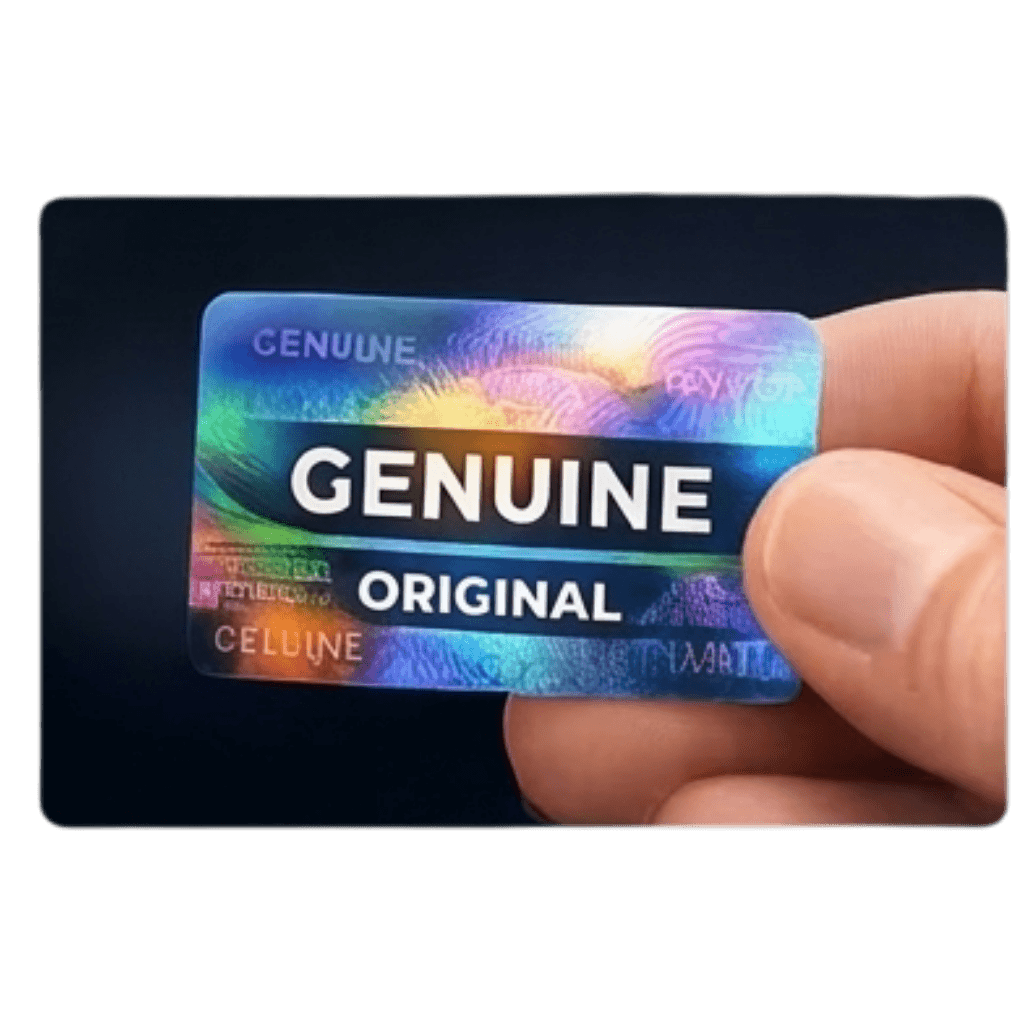
- Holographic labels let anyone check authenticity on sight, with no app, scan, or network connection needed.
- The main types are 2D/3D embossed holograms, tamper-evident holograms, and void-effect labels, each solving a different part of the problem.
- Holograms alone give no scan data. Pairing one with a QR code adds unit-level tracking without losing the no-device visual check.
- The biggest vendor question is who controls the hologram’s origination equipment, since that determines how hard the label really is to duplicate.
A retail staffer checking a product for authenticity doesn’t have time to open an app, scan a code, and wait for a server response. They need to look at the label and know, in a second, whether it’s genuine. That’s the specific problem holographic security labels solve, and it’s why they remain the most widely deployed anti-counterfeiting measure at the distribution and retail level, even in a market full of QR and NFC alternatives.
How Holographic Labels Work as an Anti-Counterfeit Measure
A holographic label uses optical microstructures embossed into a reflective surface to produce an image, colour shift, or pattern that changes depending on the viewing angle. That effect is difficult and expensive to replicate without the same origination equipment used to make the genuine label, which is what makes it a real security feature rather than decoration. Unlike a printed barcode or QR code, a hologram doesn’t need a scan to verify. A trained eye, or in some cases an untrained one, can check it on the spot.
The Main Types of Holographic Labels
2D/3D holograms use embossed microstructures to create depth or motion effects visible from different angles. These are the most common security hologram type and the hardest to reproduce without specialised origination equipment.
Tamper-evident holograms are designed to fracture, leave a residue pattern, or visibly change when someone tries to peel or reapply them, so a resealed package shows evidence of interference even if the hologram itself is genuine.
Void-effect labels leave a permanent “VOID” or similar pattern on the surface underneath once removed, making reuse on a different product immediately obvious.
Acviss covers the technical detail of these variants and how they compare on manufacturing cost and tamper resistance in the Hologram Labels glossary entry.

See Uniqolabel in action
See how Uniqolabel combines origination-controlled holograms with an optional QR data layer.
Explore UniqolabelHolograms vs QR, NFC, and Invisible-Layer Authentication
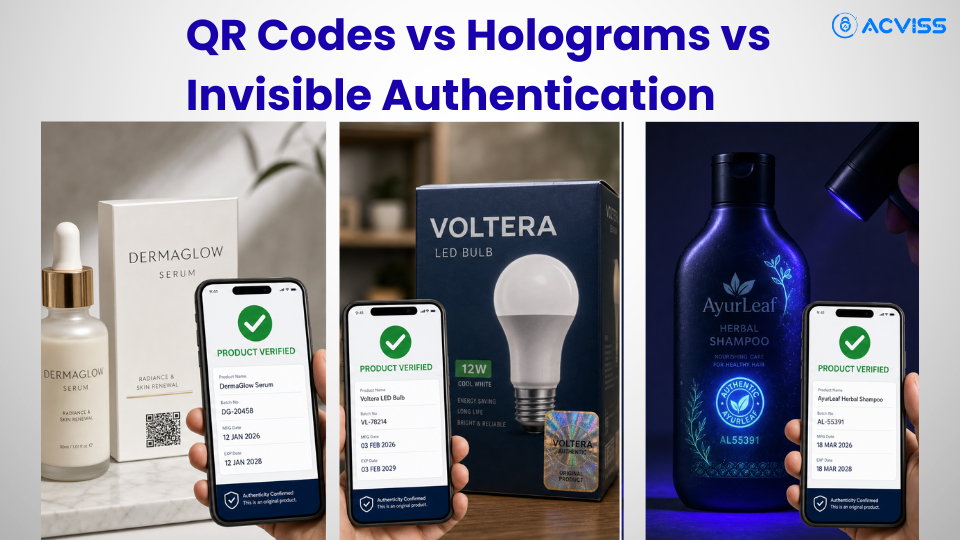
None of these approaches are strictly better than the others. They solve different parts of the same problem, and most serious anti-counterfeiting programmes use more than one:
- Holograms work without a device, at the point of sale or distribution, and don’t depend on network connectivity. They’re weaker on data: a hologram alone can’t tell a brand who scanned it, where, or when.
- QR codes give a brand a mobile-verifiable link to a specific unit’s record, plus scan-location data for detecting where fakes are entering the market, but require the consumer to scan.
- NFC tags offer a tap-based check with more data than a hologram but need an NFC-capable device and, in cost-sensitive categories, add more per-unit expense than a printed hologram.
- Invisible or covert layers (embedded in packaging artwork at the pre-press stage) leave no visible security marker at all, which protects against counterfeiters who copy the visible design of a genuine label, but they require a dedicated reader to check.
Acviss’s own comparison of these approaches in QR Code vs Hologram Label vs Invisible Layer For Your Brand goes further into which combination fits which product category and price point.
What to Check Before Choosing a Holographic Label Vendor
- Origination control. Ask whether the vendor owns and controls its own hologram origination equipment, or licenses it. A vendor that doesn’t control origination can’t fully guarantee the master isn’t duplicated elsewhere.
- Combination with a data layer. A hologram alone gives no scan analytics. Pairing it with a QR code or serialised number lets a brand track where and how often labels are being checked, closing the biggest gap holograms have on their own.
- Application-line compatibility. A label that performs well in testing but jams, misaligns, or fails adhesion at real production-line speed creates its own packaging problem, covered in Common Packaging Line Problems and How to Fix Them.
- Tamper-evidence, not just authenticity. A label that proves a product is genuine but doesn’t show whether the package was opened and resealed only solves half the problem for categories like pharma and food where tampering is the bigger risk.
Where Uniqolabel Fits
Acviss Uniqolabel is built specifically for distribution-level authentication that doesn’t depend on a smartphone: patented holographic labels that retail and distribution staff can check visually, with the option to pair the same label with a QR layer for consumer-facing verification and scan analytics where a brand wants both. That combination addresses the biggest limitation of a hologram-only approach without giving up the no-device, point-of-sale check that makes holograms useful in the first place.
Counterfeit packaging and label fraud remain a documented enforcement priority for India’s regulatory bodies, with CGPDTM continuing to flag counterfeit and mislabelled goods as an active area of IP enforcement, which keeps physical, no-device authentication features like holograms relevant even as digital-first alternatives grow.
A holographic label only works as a security feature if a brand actually controls how it’s made and where it’s applied. Book a demo to see how Uniqolabel combines holographic origination control with an optional QR data layer, so distribution staff get an instant visual check and the brand gets the scan data a hologram alone can’t provide.

Get a label distribution staff can trust on sight
Book a free demo and see how Uniqolabel pairs holographic authentication with scan-level data.
Book a Free DemoRelated reading

How Kitply Doubled Sales Implementing Product Authentication
Kitply Industries is one of the most recognized names in Indian plywood. Decades of market presence, a reputation built on quality, and dist
QR Code vs Hologram Label vs Invisible Layer For Your Brand
In this article Overview: Three Authentication Methods Side by Side QR Code Authentication: Strengths, Weaknesses, and When to Use It