

- The rules are notified. Compliance starts in 2027
- From disclosure to accountability
- What the 2026 amendments actually change
- Dark patterns turn interface design into a compliance issue
- Why this matters to brands, not just marketplaces
- The missing layer: proving what is actually genuine
- The enforcement model is becoming more proactive
- What brands should change operationally
- Where companies can still get this wrong
- What has actually changed in 2026?
 Arun Krishnan2026-09-1510 min read
For years, marketplace transparency in India has been discussed as a consumer-rights issue: show the price, disclose the seller, provide a grievance mechanism and do not mislead the buyer. The regulatory direction in 2026 goes considerably further. The focus is moving from whether information exists somewhere on a platform to whether the platform’s pricing, rankings, promotions, data practices and interfaces can influence a consumer without sufficient transparency.
That distinction matters for both marketplaces and brands. The Consumer Protection (E-Commerce) (Amendment) Rules, 2026, alongside stronger action against dark patterns and the wider move towards ex-ante digital regulation, points towards a different operating model. Platforms are increasingly expected to demonstrate that their systems themselves are not creating misleading outcomes. For brands, meanwhile, marketplace transparency is becoming inseparable from product authenticity, seller accountability and the ability to identify where digital abuse is occurring.
India’s marketplace rules may have taken years to evolve, but 2026 marks a meaningful transition: the rules have now been notified, while implementation begins on 1 January 2027.
The rules are notified. Compliance starts in 2027
There is an important distinction between the status of the rules and their effective date.
The Department of Consumer Affairs has formally notified the Consumer Protection (E-Commerce) (Amendment) Rules, 2026, amending the existing Consumer Protection (E-Commerce) Rules, 2020. The government announced the amendments on 10 September 2026, confirming that they are intended to strengthen provisions covering consumer grievances, search results, sponsored listings, price reductions, dark patterns and seller disclosures.
However, the amended rules come into force on 1 January 2027. So, as of September 2026, the amendments are no longer simply under discussion or consultation, but the new requirements have not yet reached their operative compliance date.
That makes the current period particularly important for marketplaces. The regulatory debate has moved into an implementation phase, giving platforms time to assess their pricing systems, ranking mechanisms, consumer-data practices, seller information and dark-pattern controls before the new obligations take effect.
From disclosure to accountability
India’s 2020 e-commerce rules established a baseline for marketplace conduct, including obligations around seller information, grievance redressal and transparency in commercial relationships.
The 2026 amendments change the emphasis.
Instead of simply asking whether a marketplace has disclosed information, regulators are increasingly asking whether the platform’s systems and practices produce fair outcomes for consumers.
This is an important shift because modern marketplaces are not passive catalogues. Search algorithms determine which products consumers see. Recommendation engines influence what they consider. Promotional mechanisms determine perceived value. Platform data can potentially influence which sellers receive visibility.
The regulatory question is therefore becoming much broader: Can a consumer reasonably understand why they are seeing a particular product, price or offer?
That is where several of the 2026 changes become operationally significant.
What the 2026 amendments actually change

The amendments strengthen several areas of the existing framework rather than creating an entirely new e-commerce regime.
1. Discount transparency becomes measurable
One of the clearest changes concerns pricing.
When a price reduction is announced, marketplaces must display the reduced price alongside the “prior price”. The prior price is defined as the lowest price at which the goods or services were offered during the preceding 30 days.
This makes discount claims considerably harder to manipulate.
For marketplace operators, the requirement is not merely a user-interface change. It creates a data-governance challenge involving historical pricing records, SKU-level consistency and controls capable of validating the reference price.
For brands, it also means promotional pricing across channels needs greater discipline. A price displayed on a marketplace can no longer be treated as an isolated marketing decision.
2. Search rankings come under scrutiny
Search visibility has become one of the most commercially valuable assets on an e-commerce platform.
The amended rules prohibit e-commerce entities from manipulating search results in ways that mislead users or adversely affect the relevance of results to their queries. Sponsored listings must also be identified through clear and prominent disclosures.
This does not mean marketplaces have to publish their complete algorithms. The practical implication is that they need stronger governance around the factors influencing visibility.
Businesses may need to understand and document:
- Which ranking parameters materially affect product visibility
- How sponsored placement is separated from organic discovery
- Whether commercial relationships can influence supposedly relevant results
- How ranking changes are tested and monitored
- How complaints about misleading discovery are investigated
The bigger issue is that algorithmic transparency is becoming part of consumer protection.
Dark patterns turn interface design into a compliance issue

Marketplace transparency cannot be separated from the growing regulatory focus on dark patterns.
The CCPA’s framework addresses deceptive practices including false urgency, nagging, drip pricing, basket sneaking, confirm shaming, forced action, subscription traps and disguised advertisements.
The significance for marketplaces is easy to underestimate.
A dark pattern does not necessarily involve false information. A platform may technically disclose everything while designing the customer journey in a way that makes one choice substantially easier, more visible or psychologically compelling than another.
The 2026 e-commerce amendments add another operational requirement: e-commerce entities must comply with the dark-pattern guidelines, undertake a yearly self-audit and prominently display a certificate of compliance.
That means compliance teams increasingly need to look beyond legal copy and examine the actual customer journey.
A practical marketplace transparency checklist
| Area | What needs greater scrutiny |
|---|---|
| Pricing | Historical price records and discount claims |
| Search | Ranking parameters and manipulation controls |
| Advertising | Clear separation of sponsored and organic listings |
| Consumer data | Express and affirmative consent for specified uses |
| Checkout | Prevention of unrelated bundled charges |
| Interfaces | Dark-pattern detection, remediation and annual audits |
| Complaints | Recorded complaint copies and stronger escalation |
| Imported goods | Importer details and country-of-origin disclosures |
The operational challenge is that different functions now own different pieces of the same compliance problem.
Legal may own the interpretation. Product owns the interface. Engineering owns the algorithm. Data teams control relevant datasets. Marketplace operations manage sellers. Customer support receives complaints.
Without cross-functional governance, compliance can become fragmented even when every individual team believes it is doing its part.
Connect marketplace compliance with brand protection
Turn suspicious listings, seller evidence, and authenticity signals into an operational response.
Why this matters to brands, not just marketplaces
There is a tendency to view the 2026 amendments as something marketplace operators need to worry about.
That is too narrow.
Brands increasingly operate in an environment where their digital presence can be altered by third parties without authorisation. A counterfeit seller can copy product imagery, create misleading listings, misuse trademarks and potentially manipulate consumers through false claims.
The marketplace may have a seller-verification process, but that does not mean the brand has visibility across the entire digital ecosystem.
This is where online brand protection becomes strategically connected to marketplace transparency.
A brand needs to know not simply that a suspicious listing exists, but who is selling it, what product is being represented, where it is appearing, what evidence suggests it is unauthorised and how quickly it can be investigated.
The answers form the basis of an effective enforcement workflow.
The missing layer: proving what is actually genuine
There is another limitation that regulation alone cannot solve.
Better disclosure can tell a consumer who the seller is or what country a product came from. It does not necessarily prove that the physical product inside the package is genuine.
Consider a common marketplace scenario. An unauthorised seller uses the correct brand name, legitimate-looking photographs and an authentic product description. The listing may satisfy disclosure requirements while the physical item being delivered is counterfeit.
This is why digital transparency and product authentication need to work together.
Authentication technologies can establish whether a specific product or security identifier corresponds to a genuine item. Online monitoring can identify suspicious listings before or after consumers encounter them. Supply-chain traceability can provide additional evidence about where the product originated and how it moved.
These are complementary controls, not substitutes.
The enforcement model is becoming more proactive
The broader regulatory direction is arguably more significant than any individual rule.
India is moving towards an ex-ante model, particularly in digital competition policy. The proposed Digital Competition Bill introduces the concept of Systemically Significant Digital Enterprises and seeks to address problematic behaviour before market structures become irreversible.
The proposed restrictions on self-preferencing and misuse of non-public business-user data illustrate the same philosophy: digital platforms are increasingly expected to prevent harmful behaviour rather than simply respond after consumer or competitor damage occurs.
For brands, this changes the strategic question.
Instead of asking, “How do we respond when a counterfeit listing is reported?”, the more useful question becomes, “How do we continuously identify, prioritise and act on suspicious activity before it becomes commercially significant?”
That requires monitoring infrastructure rather than occasional manual searches.
What brands should change operationally
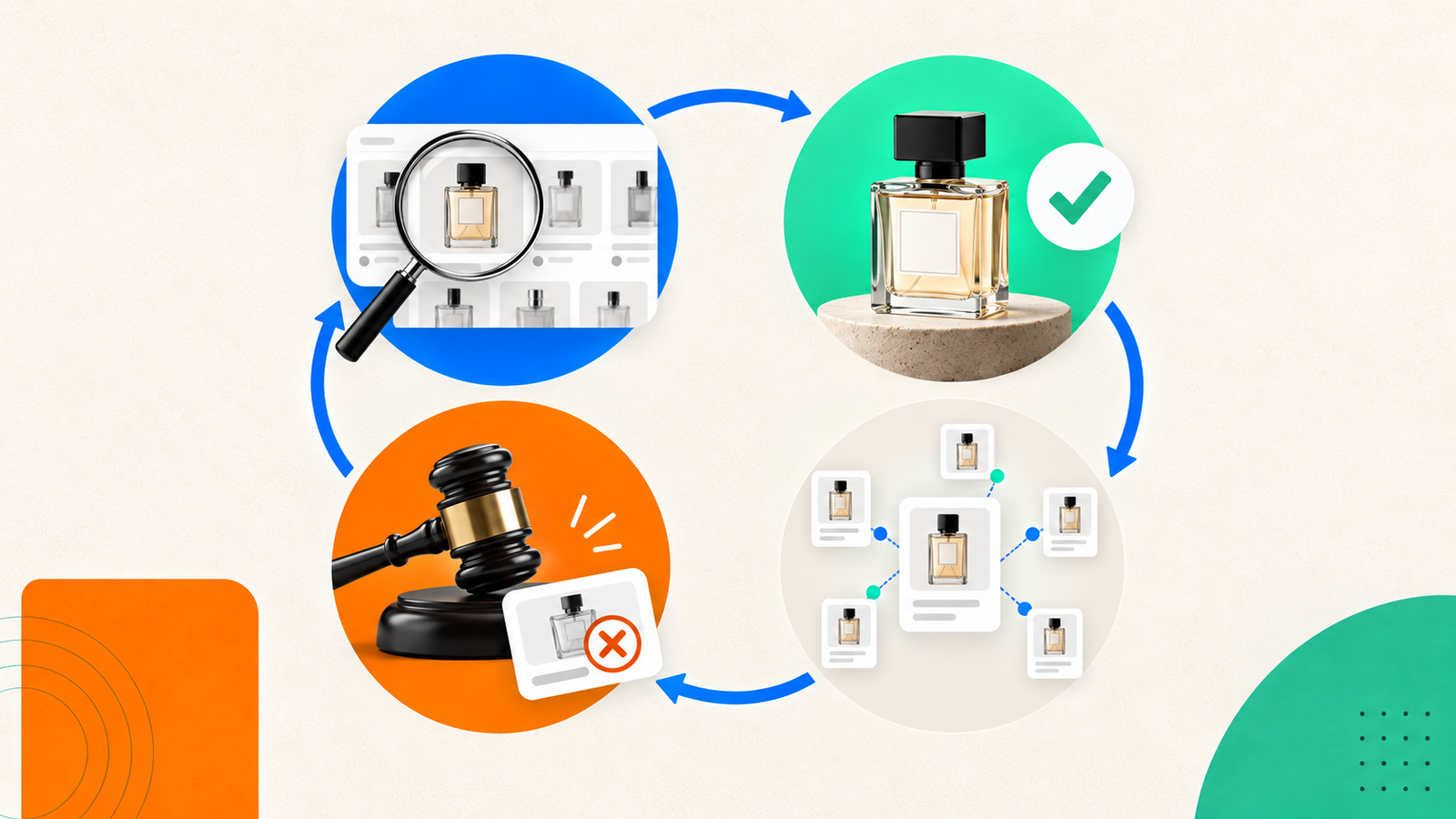
The regulatory shift is a good reason for brands to reassess how they manage digital marketplace risk.
A practical operating model should connect four layers:
- Discover Continuously identify suspicious listings, sellers, domains, advertisements and social profiles.
- Validate Determine whether the product, seller, claim or digital asset is authorised or genuine using available brand and product evidence.
- Investigate Connect related signals such as seller identities, repeated product imagery, pricing anomalies, marketplace accounts and geographic patterns.
- Enforce and learn Submit appropriate takedown or enforcement actions, record outcomes and use the resulting intelligence to improve future detection.
Platforms built for online brand protection, such as Acviss Truviss, fit into this layer by helping brands monitor their digital footprint and identify potentially infringing activity. The value, however, lies less in simply finding listings and more in converting scattered digital signals into an actionable investigation and enforcement process.
Where companies can still get this wrong
More regulation does not automatically produce better protection.
Treating compliance as a legal exercise remains a common weakness. A policy document cannot compensate for an opaque ranking system, weak seller controls or fragmented complaint data. Compliance needs operational ownership.
Relying entirely on marketplace reporting can also leave blind spots. Marketplaces are important enforcement partners, but brands need independent visibility into what is happening across digital channels.
Monitoring without prioritisation creates another problem. Thousands of suspicious listings do not necessarily represent thousands of equally important threats. Detection systems need risk scoring based on factors such as sales potential, consumer exposure, repeat offenders and product criticality.
Separating online and offline authenticity is equally problematic. A suspicious listing and a counterfeit physical product are two sides of the same problem. Digital investigation should ultimately connect with product authentication, distribution intelligence and, where relevant, warranty or customer-claim data.
Finally, transparency should not be confused with authenticity. A consumer knowing who the seller is does not guarantee that the product is genuine. Transparency improves informed choice; authentication establishes product integrity.
What has actually changed in 2026?
The important change is not simply that India has introduced another set of e-commerce requirements.
It is that the regulatory model is becoming more demanding about how digital marketplaces operate, rather than only what information they disclose.
The first generation of digital regulation largely focused on disclosure: tell consumers what they need to know.
The emerging model adds accountability: demonstrate that the systems influencing consumer decisions are not deliberately misleading them.
The next challenge is likely to be verifiability: can consumers, brands and regulators independently establish whether the information being presented corresponds to reality?
That question extends well beyond pricing and search rankings. It reaches seller identity, product origin, authenticity, reviews, advertising, supply chains and the digital infrastructure surrounding commerce.
For brands, this makes online brand protection less of a defensive enforcement function and more of a source of operational intelligence. Organisations that can connect marketplace monitoring with authentication, traceability and investigation workflows will be better positioned to understand not only where abuse occurs, but how it moves through the ecosystem.
India’s marketplace rules may have taken years to evolve, but 2026 marks a meaningful transition: the rules have now been notified, while implementation begins on 1 January 2027.
For marketplaces, the months ahead are therefore less about debating whether transparency requirements are coming and more about determining whether their systems are ready for them.
For brands, the implication is broader. Preparing for this environment means looking beyond compliance checklists and building the visibility required to establish what is genuine, what is authorised and what needs intervention.
Interested in strengthening your brand’s protection across the digital ecosystem? Get in touch with Acviss to explore how online brand protection, authentication and digital intelligence can work together.
Build continuous visibility across digital marketplaces
Combine online monitoring, product authentication, and investigation workflows with Acviss.
Related reading

Online Brand Protection: The Complete Guide for D2C and Marketplace Brands
Read related Acviss guidance.

Counterfeit Intelligence vs Brand Monitoring: Why They Aren’t the Same Thing
Read related Acviss guidance.