
- It's not the impersonation, it's the checkout
- How the account gets built to look real, fast
- Where the money actually changes hands
- Why manual reporting can't keep pace
- Why this is your problem, not just security's
- The missing layer: catching the pattern, not the complaint
- What to tell customers who already paid
- Where brands still get this wrong
- The pattern was always there. The scale is what changed
 Arun Krishnan2026-09-178 min read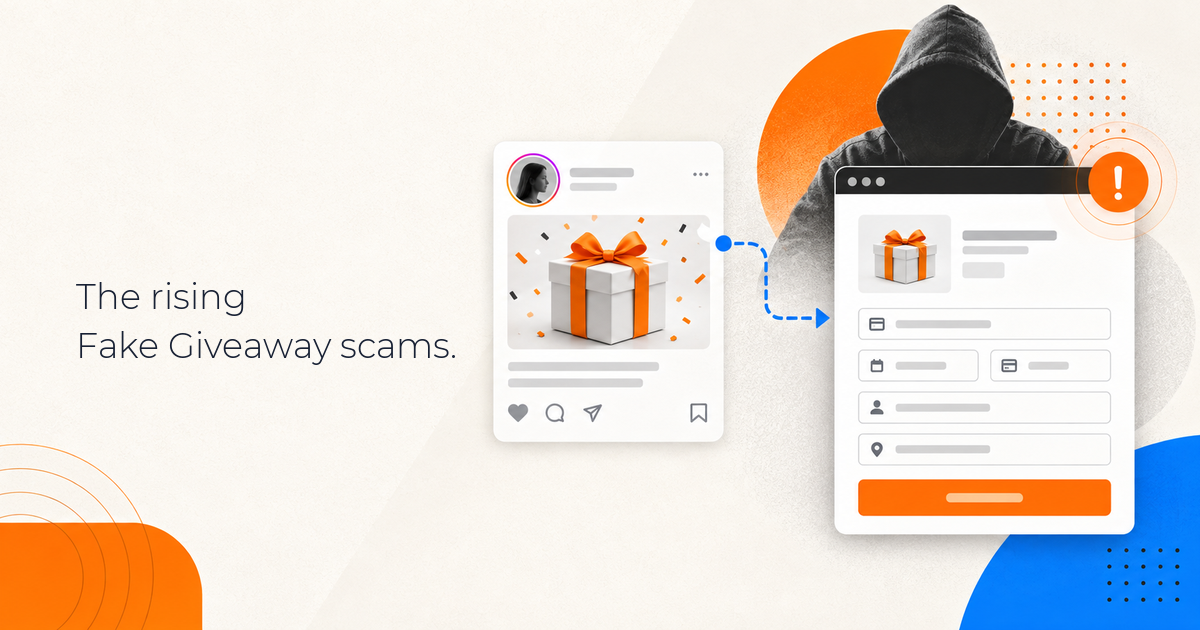
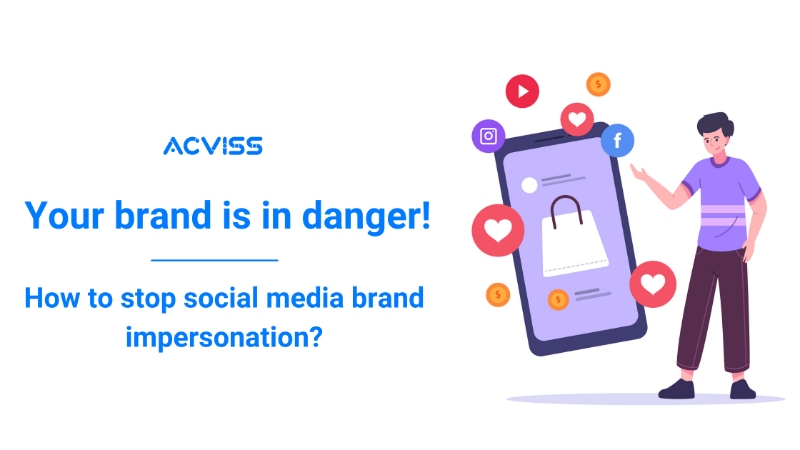
An account impersonating your brand is running a "giveaway." Same logo, a handle that is one character off, thousands of comments tagging friends. The old instinct is to treat this the way you treat any impersonation account: report it, wait for the platform to act, move on.
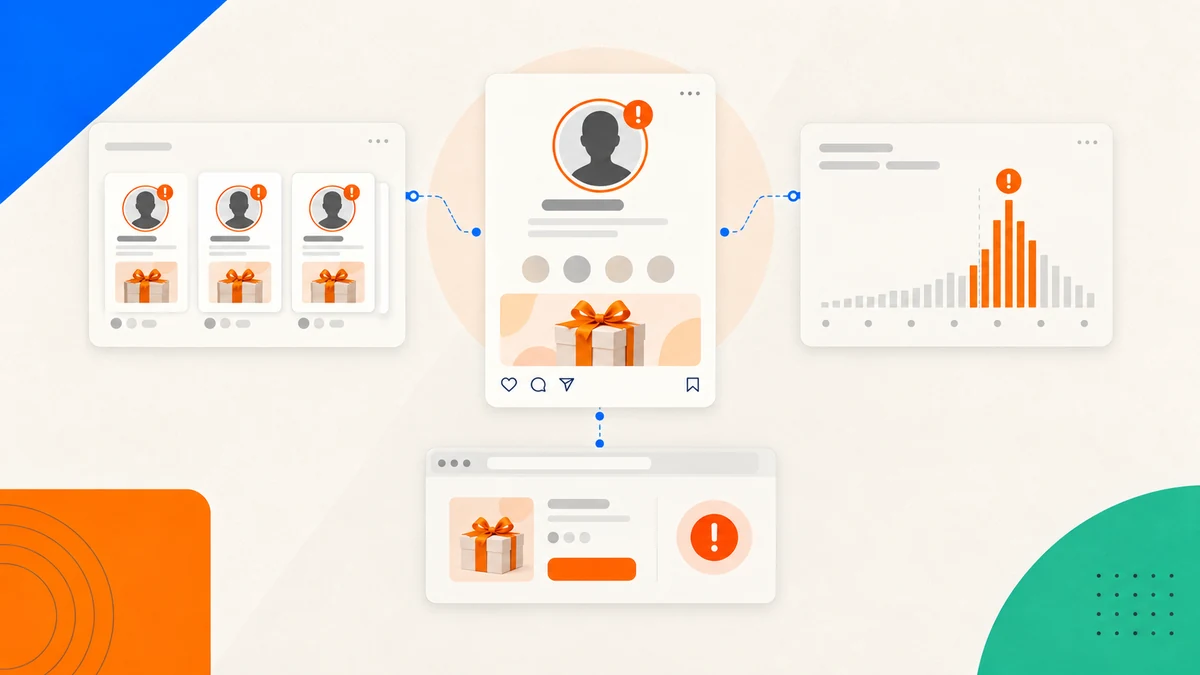
That instinct is missing the part that actually matters. The account is not where this ends. A cloned checkout or payment step is, and that is where a customer's money or login credentials actually leave their control, often before your brand even knows the account exists.
TL;DR: The danger in a fake giveaway account isn't the account. It's the checkout page behind it. If your monitoring only watches for lookalike accounts and not for the payment or login step they link out to, you are watching the wrong end of the scam.
It's not the impersonation, it's the checkout
An impersonation account with no monetisation step is a trust problem. It can embarrass a brand or confuse a follower, but nobody's money moves.
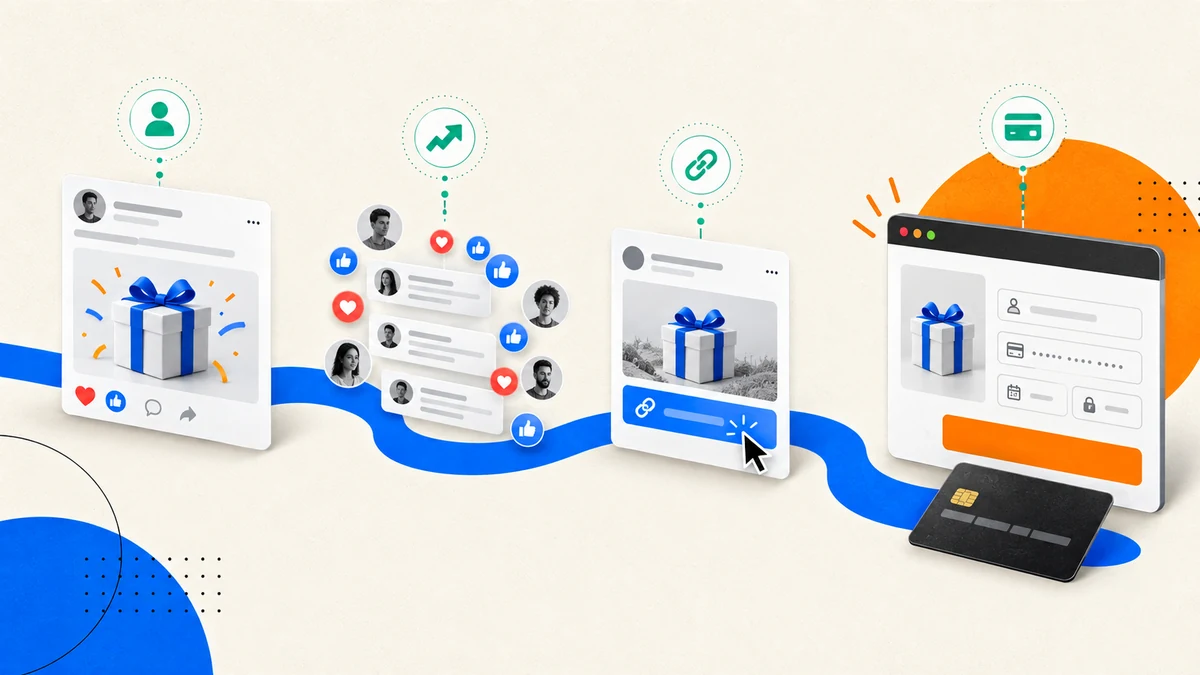
Add a giveaway and a payment step, and the same borrowed trust converts directly into a financial transaction the brand never authorised and never sees until a customer complains. This handoff is well documented on Instagram: winners are routed to a fake login page that harvests credentials, or asked for a small fee to "release" a prize. The same pattern has been tracked on Facebook, where winners are asked for card details "for verification" or to cover shipping. It isn't theoretical: a Black Friday 2025 malvertising sweep ran over 100 fake domains promising branded prizes, a Walmart candy hamper, a Coca-Cola mini-fridge, a LEGO set, a Louis Vuitton accessory, a Home Depot bundle, from more than 20 real brands, each one funnelling entrants to a "reward" page asking for card details to cover a $7-$12 "shipping fee."
That is a different problem from routine account impersonation, and it needs a different response. It is also a different problem from counterfeit products riding on fake reviews and cloned social proof: that pattern sells a fake product through borrowed trust. This one skips the product entirely and takes the payment or the credentials directly.
How the account gets built to look real, fast
Three things happen, usually in this order, and each one narrows what your team can rely on to catch it.
1. The clone. The pattern documented above starts here: the logo, profile photo and handle are copied or near-identical, and recent posts are lifted or lightly reworked from the real account. The clone doesn't stop at static images either: fake "$20 million crypto giveaway" videos on X used deepfaked footage of Elon Musk to run the same fee-to-release trick in 2025, timed to real Tesla and SpaceX news cycles so the clip read as plausible rather than fabricated. Visual similarity alone cannot be the detection trigger, because it is deliberately good.
2. The inflation. Followers, likes, comments and shares are bought or bot-driven, or the giveaway post itself is "like-farmed" to clear the credibility threshold a casual viewer uses before trusting a page. The Better Business Bureau describes this like-farming pattern directly: a page harvests engagement toward a target, then gets repurposed or sold once it hits that number. A sudden, disproportionate spike in engagement relative to account age is a stronger signal here than raw follower count, and it is the same engagement-inflation playbook fake influencer accounts use to look credible fast.
3. The timing. The post lands around a real brand moment, a launch, a seasonal campaign, so it reads as plausible rather than opportunistic. Monitoring that only runs periodically will systematically miss the window when this tactic works best.
None of this happens in isolation. Research into the "SniperDz" phishing-as-a-service ecosystem documented fraudulent social accounts promoting free offers, routed through link-aggregator pages that conceal the real destination, sitting on top of 80-plus ready-made phishing templates impersonating 30-plus global brands. That infrastructure was real enough that INTERPOL's Operation Ramz dismantled it across 13 countries in 2026, arresting over 200 people and recovering more than 45,000 victim records, accounts that had promoted phishing links "disguised as promotional offers." A review of four recent impersonation incidents confirms the account-to-external-payment funnel is active in practice across Facebook, WhatsApp and Telegram, even though none of those four specific cases is a giveaway. The pattern, not the label, is what to watch for.
Where the money actually changes hands
The "winner" is not paid. They are routed one step further: to a fake login page harvesting account credentials and MFA codes, or to a request for a small "shipping," "processing" or "tax" fee alongside card details, on a page styled to resemble a real checkout or brand portal. In India, this fee-escalation version runs almost entirely on WhatsApp: messages carrying Reliance Jio and SBI branding tell recipients they've won a lakhs-worth "KBC lottery," and once a "processing fee" is paid, the prize amount is raised and a second fee is requested, a repeat-payment loop that Delhi Police's Cyber Cell has been debunking for years.
Consumer-protection guidance on this is consistent and unambiguous. A genuine giveaway never requires the winner to pay to release a prize. Multiple consumer-protection bodies make that point directly, and it is worth repeating to anyone your brand needs to reassure.
This is also where platform choice matters. The FTC's most recent social-media-scam data names Facebook as the highest-loss platform for scams overall, with WhatsApp and Instagram next, which lines up with where this specific funnel tends to run. That figure covers social-media scams broadly, not giveaway scams as their own reported category, but it tells you where to weight a monitoring effort.
If your team needs the reader-facing version of these red flags, a practical checklist for spotting a cloned checkout or payment page covers the payment-step warning signs directly, which is useful to share with customers who ask.
See what a monitoring programme should actually be watching for.
The signal that matters is the pattern (clone, plus engagement spike, plus outbound payment link), not the giveaway label.
Why manual reporting can't keep pace
Reporting an account is inherently reactive. It joins a queue behind general content moderation, on the platform's own schedule, while the account-and-kit side of this operation is built for speed and reuse. This is one application of the broader case for proactive over reactive monitoring, which holds across brand protection generally, not just for giveaway accounts.
Even a well-resourced platform's own numbers make the point. Meta's 2025 enforcement disclosure states that 92% of the 159 million scam ads it removed that year were caught proactively, before anyone reported them. If the platform with the most resources to police this treats user reports as a secondary signal rather than its primary control, a single brand's manual reporting queue is not built to be the main defence either.
The infrastructure underneath compounds this. That same phishing-as-a-service ecosystem ran on 900-plus domains behind its 80-plus templates: redeployable infrastructure built to survive any single takedown, which is exactly why it took a 13-country INTERPOL operation, not a single platform report, to bring it down. Removing one account removes one instance, not the capability to stand up the next one an hour later.
Manual reports still move through a human review queue, one submission at a time, while the account and its outbound link keep converting in the background. The SniperDz takedown above makes the scale of that mismatch concrete: a single phishing-as-a-service operation ran for roughly nine years and needed a coordinated, 13-country law-enforcement operation to shut it down, not a stream of individual platform reports. A brand waiting on its own report to clear is not on that same timeline, and shouldn't assume it is.
None of this removes the need to report an account today. A step-by-step guide to filing that report is still the right immediate action while the pattern-based monitoring case below is being built out.
| Signal | What it means for your monitoring window |
|---|---|
| Near-miss handle with cloned visuals | Still early: the account is set up but hasn't yet forced a decision |
| Sudden engagement spike disproportionate to account age | Already converting: the credibility threshold has likely been cleared |
| Urgency-framed prize language ("winner in 1 hour") | Already converting: the account is actively pushing traffic toward the funnel step |
| Any outbound link off-platform toward a login or payment page | Already scaled: assume some followers have already reached the extraction step |
Why this is your problem, not just security's
It is tempting to assume this sits with IT, security or legal once it involves fraud. It does not sit there first.
The account is impersonating your marketing presence and spending the trust your own team built. A customer who loses money to it blames the brand, not an anonymous scammer, regardless of which internal team eventually handles the takedown.
The earliest useful signal, a suspicious "giveaway" account gaining traction unusually fast, is something a marketing or social lead is best placed to notice first, well before it becomes a formal security incident.
The missing layer: catching the pattern, not the complaint
A brand relying only on customer complaints and manual reporting is, by construction, always looking at this pattern after it has already scaled past the easiest point to stop it.
What closes that gap is watching for the pattern itself, cloned visuals, a disproportionate engagement spike, and an outbound link toward a payment or login step, across the platforms where this actually happens: Instagram, Facebook, WhatsApp and Telegram. That is a category of monitoring, not a single report filed after the damage is visible.
Truviss is Acviss's online brand protection solution. It is named here to describe that category, pattern-based monitoring of social presence, rather than as a claim about how quickly any specific tool catches this exact scam.
What to tell customers who already paid
The brand's responsibility here is communication and evidence, not automatic reimbursement.
Tell the customer to contact their card issuer or bank promptly to dispute the charge; that is the single most time-sensitive step. The FTC's imposter-scam guidance and the consumer-protection guidance cited earlier point the same way: report the account or page to the platform directly, and file a report with a recognised consumer-fraud body in the customer's own country.
On the brand's side, publish a clear statement from a verified channel that the account is not affiliated, give customers a reporting path, and preserve evidence, screenshots, handles, the payment-page URL, to support both the customer's dispute and your own takedown request.
Where brands still get this wrong
Waiting for a completed, provable customer complaint before treating a fast-growing lookalike account as urgent is the most common mistake. By the time a complaint is fully documented, the account has usually already converted a meaningful share of the audience it was ever going to reach.
A close second is assuming a modest current follower count means there is no urgency. The growth curve, not the current size, is the risk signal, and a small account today can clear a credible-looking threshold within hours if it is being inflated deliberately.
The third is treating this identically to routine impersonation monitoring, watching for lookalike accounts in general without specifically watching for the outbound payment or login step. That step is the point that actually matters, and a monitoring approach that stops at "does this account look like us" will miss it every time.
The pattern was always there. The scale is what changed
Manual reporting was adequate when impersonation accounts were rare and slow to build by hand. Productised cloning tools and bought engagement changed that growth curve, without changing what the platforms themselves consider a primary control.
The same cloned checkout step that extracts a customer's money is also the clearest, earliest signal available, if a brand is watching for the pattern rather than waiting for the complaint. Catch the pattern before the growth curve outruns you: book a demo with Acviss and ask how Truviss, Acviss's online brand protection solution, fits into that approach.
Watch for the pattern, not just the account
See what a brand-protection monitoring programme should actually watch for, then book a demo to see how Truviss fits into that approach.
Related reading
Why Social Commerce Is Your Biggest Unmonitored Counterfeit Channel
Read related Acviss guidance.
Online Brand Protection: The Complete Guide for D2C and Marketplace Brands
Read related Acviss guidance.