

- Overview: Three Authentication Methods Side by Side
- QR Code Authentication: Strengths, Weaknesses, and When to Use It
- Holographic Labels: Strengths, Weaknesses, and When to Use Them
- Invisible Authentication: Strengths, Weaknesses, and When to Use It
- The Combined Approach: When One Layer Is Not Enough
- Decision Framework: Five Questions to Help You Choose
- Frequently Asked Questions
- Not Sure Which Authentication Method Is Right for Your Product?
QR Code vs Hologram Label vs Invisible Layer For Your Brand
 Mithileshkumar R NaikMay 19, 202611 min read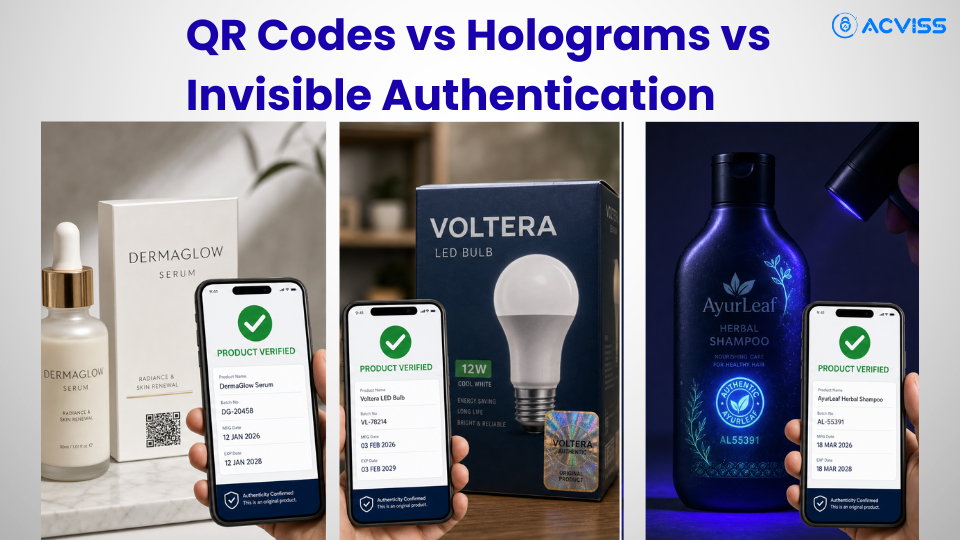
- QR codes are easy for consumers to scan and verify but can be photographed and reused if not paired with a non-clonable identifier.
- Holograms give instant visual verification without a smartphone but can be replicated by sophisticated counterfeiters over time.
- Invisible/covert layers are harder for counterfeiters to detect and copy, but require special tools or training to verify.
- The right choice depends on the product category, price point, and how much consumer-facing verification the brand actually needs.
Each option maps to a different point on the hologram labels spectrum of visible-vs-hidden security — relevant background if you’re also weighing why ERP isn’t enough for manufacturing traceability, covered in this guide.

Most brands choose their anti-counterfeiting method the wrong way. They pick what their largest competitor uses, or they choose the option with the lowest unit cost, or they go with whatever their packaging supplier recommended. The result is a mismatch between the threat their brand actually faces and the solution they have deployed.
A holographic label on a pharmaceutical product that is being counterfeited by organized crime is a speed bump, not a barrier. A cryptographic QR code on a product sold primarily in rural markets where consumers will not scan it is an expensive feature that no one uses. Invisible authentication on a product where distribution-level verification is the bigger need solves the wrong problem.
Choosing the right authentication method starts with understanding your specific threat model: who is counterfeiting your product, at what level of sophistication, in which markets, and who is best positioned to detect the fake. This post breaks down each method honestly, including the weaknesses, and gives you a framework to match the method to your actual situation.
Overview: Three Authentication Methods Side by Side
| Factor | QR Code Authentication | Holographic Labels | Invisible Authentication |
|---|---|---|---|
| How verification happens | Consumer or inspector scans code with smartphone; result returned digitally | Visual inspection; rainbow effect, color shifts, or hidden image visible to naked eye or UV light | Scanning device or app reads embedded pattern invisible to the naked eye |
| Consumer verification ease | High, especially via WhatsApp (no app needed) | High for basic hologram; lower for complex features that require training | Low for consumers; requires a dedicated reader or app |
| Counterfeit-resistance level | High when code is cryptographically unique and non-clonable; low if standard QR | Medium; basic holograms are increasingly replicable by organized counterfeiters | High; invisible patterns embedded at pre-press stage are extremely difficult to replicate |
| Packaging change required | Minor; add printed code to existing artwork | Moderate; label or seal must be added to packaging | Minimal; pattern embedded in existing artwork at pre-press stage |
| Cost tier | Low to medium depending on serialization complexity | Medium to high depending on hologram specification | Medium; upfront pre-press integration with low per-unit cost |
| Best industries | FMCG, pharma, agro, consumer electronics, any consumer-facing brand | Luxury, premium FMCG, spirits, tobacco, government documents | High-security documents, premium packaging, brands with sophisticated supply chain inspection |
QR Code Authentication: Strengths, Weaknesses, and When to Use It

How it works
A unique QR code is printed or applied to each product unit. The code contains an identifier that links to a brand’s authentication database. When a consumer or inspector scans the code, the system checks whether the code is valid and whether it has been scanned before. The result is returned instantly, typically through a web browser or, in more effective implementations, through WhatsApp.
Strengths
QR code authentication is the most consumer-friendly method when implemented through a zero-friction channel like WhatsApp. It generates rich data: every scan is logged with location, time, and frequency, giving your brand a real-time picture of where products are being verified and where suspicious activity is occurring. It works on any printed surface, requires no change to your label beyond adding the code, and can be deployed across large SKU ranges without significant packaging line changes.
Cryptographic, non-clonable QR codes take this further. When the uniqueness is embedded at a level that cannot be reproduced by simply photographing and reprinting the code, QR authentication becomes a meaningful security barrier rather than just a data collection tool.
Weaknesses
Standard QR codes, the kind any packaging printer can generate, can be copied. A counterfeiter who scans your QR code, screenshots it, and prints it onto a fake product will produce a code that returns a genuine authentication result, because the database does not know the difference between your consumer scanning the original and a consumer scanning a copy. This is the critical vulnerability of QR authentication systems that do not use cryptographic uniqueness.
QR authentication also depends on consumer behavior: if consumers in your category do not scan codes, the system generates no protective value at the consumer level (though it still provides supply chain data through authorized channel scans).
When to use QR code authentication
QR code authentication, specifically with a non-clonable code and WhatsApp delivery, is the right choice for brands whose primary need is consumer-level verification at scale across India’s diverse geography. It is particularly strong for FMCG, pharmaceuticals, agrochemicals, and consumer electronics, where smartphone penetration is sufficient and consumer motivation to verify exists, especially for health and safety products.
Holographic Labels: Strengths, Weaknesses, and When to Use Them

How they work
Holographic labels use diffractive optically variable image devices, DOVID, that produce color-shifting, rainbow, or three-dimensional visual effects that are difficult to replicate with standard printing equipment. They are applied as labels, seals, or heat-transfer elements on packaging. Verification is visual: anyone who knows what the genuine hologram looks like can check it by eye, or under UV light for features embedded at that wavelength.
Strengths
Holograms are immediately visible without any device. A retail inspector, customs official, or consumer who has been shown what the genuine hologram looks like can verify at a glance. They provide a strong deterrent at the distribution and retail level, where trained staff can spot the absence or obvious replication of a hologram. They require no connectivity, no smartphone, and no app. For brands operating in markets with low smartphone penetration, or for products inspected primarily at the distribution level rather than by end consumers, holograms have practical value that digital systems cannot match.
Weaknesses
Holographic security has a well-documented escalation problem. As the technology for producing holographic labels has become more accessible, the gap between genuine and replicated holograms has narrowed. Industry reports from the International Chamber of Commerce note that sophisticated counterfeiters, particularly those producing high-volume fakes for premium product categories, have access to equipment capable of producing holograms that pass visual inspection by untrained consumers.
Holograms also carry no digital data layer. A hologram can tell you the product is genuine at the label level, but it cannot tell you where the product was manufactured, which batch it belongs to, which distributor handled it, or how many times it has been verified. For brands that need supply chain visibility alongside consumer-facing security, holograms alone do not provide it.
When to use holographic labels
Holograms are best suited as a visible deterrent layer for brands where distribution-level verification is a primary need, where the product is premium-positioned and the packaging can support the visual presence of a label or seal, and where brand associations with physical security features are valuable, such as in luxury, premium spirits, or government-regulated products. They are most effective when combined with a digital verification layer rather than deployed alone.

See Certify in action
See how Certify’s non-cloneable authentication compares to holograms and invisible layers.
Explore CertifyInvisible Authentication: Strengths, Weaknesses, and When to Use It
How it works
Invisible authentication embeds a security pattern directly into the product’s packaging artwork at the pre-press stage, before the artwork goes to print. The pattern is invisible to the naked eye and to standard scanning equipment. Verification requires a specific reader device or application that can detect and decode the embedded pattern. Because the authentication feature is part of the artwork itself, it is reproduced by every print run without any additional production step.
Strengths
Invisible authentication has two properties that no visible method can match. First, it gives counterfeiters nothing to target. A counterfeiter who can see a QR code can copy it. A counterfeiter who can see a hologram can try to replicate it. A counterfeiter who cannot see the authentication feature cannot make a strategic decision about whether and how to defeat it. Second, it adds zero cost to packaging production beyond the initial artwork integration. Once the pattern is embedded in the artwork, every print run at every supplier includes the authentication feature automatically, with no label or code to add, track, or manage.
Weaknesses
Invisible authentication requires a one-time artwork change at the pre-press stage. For brands with complex packaging across many SKUs and multiple print suppliers, coordinating this change across the full product range takes planning. More significantly, consumer-level verification requires a device or application that can read the invisible pattern. This is not a system designed for consumers to self-verify in a retail environment. It works best for supply chain inspection, customs and enforcement, and authorized retail partner verification, where trained staff use dedicated readers.
When to use invisible authentication
Invisible authentication is the right choice when your threat model involves sophisticated counterfeiters who study and replicate visible security features, when you need supply chain and enforcement-level verification rather than consumer-level self-verification, and when you want an authentication layer that survives even if your other visible security features are compromised. It is particularly powerful for premium products, high-value industrial goods, and brands whose counterfeits are produced at a level of sophistication that defeats visual inspection.
The Combined Approach: When One Layer Is Not Enough
Most serious counterfeit threats require more than one authentication layer, because a sophisticated counterfeiter will eventually defeat any single method. The question is not which method is best in absolute terms, but which combination of methods creates a threat model your counterfeiters cannot economically overcome.
A QR code tells the consumer the product is genuine. A hologram provides a visible deterrent that distribution partners and retailers can check. An invisible authentication layer gives your brand protection team and law enforcement a verification capability that counterfeiters cannot anticipate or defeat. Each layer addresses a different stage of the product journey and a different verifier.
Acviss offers all three methods within a single platform. Certify provides the patented non-clonable QR-based authentication with WhatsApp delivery. Uniqolabel provides holographic label solutions for visible deterrence and distribution-level verification. Phantom Code provides invisible authentication embedded at the pre-press stage. Brands that need a multi-layer approach can deploy any combination of these through one platform, with unified analytics and a single brand protection dashboard, rather than managing separate vendors and disconnected data sets. You can explore the full range at acviss.com/book-demo.
Decision Framework: Five Questions to Help You Choose
1. Who is your most important verifier?
If your answer is “the consumer at point of purchase,” QR-based authentication with a zero-friction channel like WhatsApp is your primary method. If it is “the distributor or retailer,” a hologram or physical security feature they can check without a device may be more practical. If it is “your supply chain team or enforcement agencies,” invisible authentication or serialized supply chain tracking is the right anchor.
2. How sophisticated are the counterfeiters in your category?
Low-sophistication counterfeiters, those producing obvious fakes for price-sensitive markets, are deterred by visible features. High-sophistication counterfeiters, those producing near-perfect replicas for premium product categories, require cryptographic or invisible methods that visible replication cannot defeat.
3. What is the geographic spread of your counterfeit risk?
If your counterfeits are concentrated in specific markets or channels, a targeted approach with strong supply chain traceability may address the root cause more effectively than packaging-level authentication alone. If fakes appear across diverse geographies and channels, consumer-facing authentication that works at scale is essential.
4. What is your packaging change tolerance?
Brands with frequent packaging changes, large SKU ranges, or complex multi-supplier print networks need authentication methods that integrate easily into existing artwork and production workflows. Both QR codes and invisible authentication have lower packaging change friction than physical label additions.
5. Do you need supply chain data or only point-of-sale verification?
If understanding where your product is in the supply chain, detecting grey market diversion, and mapping distribution leakage is as important to you as consumer-facing authentication, you need a serialization-based approach that generates scan data at every handoff, not just at the consumer’s point of purchase.
Frequently Asked Questions
Can a standard QR code be used for anti-counterfeiting?
Standard QR codes that link to a database can be photographed and reprinted onto fake products. If the database entry for that code shows “genuine,” every scan of the copied code will return the same result. For QR codes to function as genuine anti-counterfeiting, the code itself must be cryptographically unique and non-clonable, meaning the physical or digital properties of the code cannot be reproduced by standard printing.
Are holograms still effective in 2026?
Basic holograms produced by widely available equipment are less effective than they were a decade ago, because counterfeit production capabilities have improved. High-specification holograms with complex overt and covert features remain a meaningful deterrent, particularly for distribution-level inspection. Their effectiveness is highest when combined with a digital verification layer rather than used as a standalone measure.
How much does packaging change when adding authentication?
The packaging change required depends on the method. Adding a QR code to existing artwork is typically a minor print file change. Adding a holographic label requires a physical application step on the production line. Invisible authentication requires a pre-press artwork integration that, once done, requires no further production changes. Your authentication provider should be able to advise on packaging line implications before implementation.
Can I use all three methods on the same product?
Yes, and for high-value or high-risk products it is often the right decision. The three methods address different verifiers, different stages of the product journey, and different levels of counterfeiter sophistication. A multi-layer approach means that even if a counterfeiter defeats one method, the others remain intact.
Not Sure Which Authentication Method Is Right for Your Product?
Choosing without a clear threat model is the most common and most expensive mistake brands make in anti-counterfeiting. The right answer is specific to your category, your counterfeiters, your distribution structure, and your consumer base.
Our team will help you map the right solution to your threat model. No generic recommendations. No one-size-fits-all approach.
Book a demo to walk through your specific situation with the Acviss team.

Pick the right authentication layer for your brand
Book a free demo and see how Certify compares to holograms and invisible authentication.
Book a Free DemoRelated reading

How Kitply Doubled Sales Implementing Product Authentication
Kitply Industries is one of the most recognized names in Indian plywood. Decades of market presence, a
How WhatsApp Product Authentication Help Brands Fight Fakes
In this article Why WhatsApp Changes Everything for Product Authentication in India How WhatsApp-Based Authentication Works: Step by Step Wh