
Product Authentication for Seed Companies
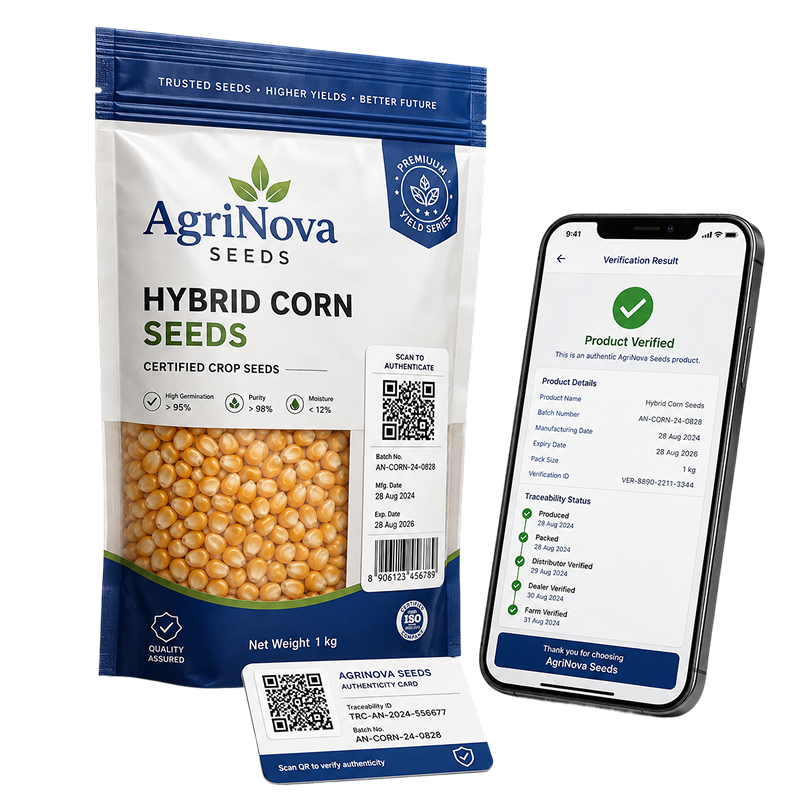
A farmer scans the QR on your seed packet before sowing to confirm the variety is genuine and certified. A dealer scans before accepting a delivery. Phantom Code on the holographic label means the identity cannot be peeled, copied, or reused. Your brand is protected from the moment the packet leaves your facility to the moment it reaches the field.




Counterfeit Seed Is Destroying Farmer Trust in Genuine Varieties
Most seed companies discover counterfeit activity after farmers file crop failure complaints. By then the sowing season is over, the yield is lost, and your variety's reputation in that region has already been damaged. These numbers show the scale of what is already in the market.
Five Seed Fraud Patterns That Damage Genuine Brands
Inferior or open-pollinated varieties are packed and sold under your certified hybrid name. Farmers pay hybrid prices but get open-pollinated germination rates and yields. Your variety's reputation takes the damage.
Counterfeit seed packets carry forged certification tags that look identical to genuine state or national agency tags. Dealers and farmers cannot distinguish them without a digital verification step.
Seed with below-minimum germination percentages is packed under your label. The physical appearance of the seed is identical. Farmers only discover the problem after the window for re-sowing has closed.
Seed supplied at subsidised rates to a state scheme is diverted to the open market and sold at full commercial price under your brand label. Your brand takes the reputational exposure when the scheme is audited.
Counterfeit seed lots carry doctored ISTA or state lab test reports showing germination and purity values that were never measured. Dealers rely on these reports to assess quality before purchase.
Four Frameworks Your Compliance Team Is Already Tracking
If you produce or sell certified seed in India, the US, Europe, or through international programmes, at least two of these apply to your varieties. Acviss maps to each framework so your team does not need separate systems for separate markets.
The PPV&FR Act grants plant breeders exclusive rights over registered varieties. Selling seed under a registered variety name without the breeder's authorisation is an infringement. Counterfeit seed using your registered variety name violates your PPV&FR registration directly.
The Federal Seed Act requires that seed in interstate commerce carry accurate labelling showing variety name, lot number, germination percentage, and certification status. Misrepresenting any of these is a federal violation.
Only varieties listed in the EU Common Catalogue may be marketed in EU member states. Certified seed must carry official certification tags. Cross-border marketing of varieties without proper catalogue registration is prohibited.
ISTA rules require that seed lots carry test certificates issued by accredited laboratories. Test certificates must accompany the seed lot through the distribution chain and be available to buyers at the point of sale.
An Identity That Cannot Be Peeled, Copied, or Reused
Certify and Phantom Code work together to give each packet an authentication layer that counterfeiters cannot reproduce. Certify generates the digital identity. Phantom Code makes the physical label non-cloneable.
Every seed packet gets a unique QR identity linked to its variety, lot, certification status, and germination data. Farmers and dealers scan with any phone camera to confirm the packet is genuine before purchase. No app needed. Counterfeit packets that are not in the Certify registry return a clear failed-authentication result.
- Unique QR per packet linked to variety and lot data
- No-app verification for farmers at rural kiosks and dealers
- Links to PPV&FR, FSA, and EU variety registration records
- Germination and purity data available on scan
- Works on small sachets, foil pouches, and bulk bag labels
- Dashboard with batch and SKU-level scan reporting
Phantom Code applies a covert, non-reproducible security layer to the holographic label alongside the visible QR. The label cannot be peeled from a genuine packet and reused on a counterfeit one. Standard printers and copiers cannot reproduce the Phantom Code layer. When a counterfeiter copies the visible QR, the Phantom Code check still fails.
- Non-reproducible layer that defeats peel-and-reuse attacks
- Works on holographic labels for seed packets and bulk bags
- Covert check that counterfeiters cannot detect or copy
- Verified using standard smartphone cameras in low-connectivity areas
- Combined Certify plus Phantom Code labels available
- Tamper-evident construction alerts if label is disturbed
"Acviss's Yellow Label and Origin successfully eliminated our counterfeit threats with complete security across the supply chain."
See How Acviss Supports Seeds Product Authentication
Get a tailored product authentication plan for your Seeds products and channels.
- ✅ Risk Audit: We map your Seeds product, channel, and customer journey.
- ✅ Live Demo: See Acviss product authentication workflows on your use case.
- ✅ Tailored Rollout: Get a practical deployment plan for your products and existing systems.
Trusted by Leading Brands
Protect Products.Build Trust.
Questions Seed Company Teams Ask Us
Farmers Deserve to Know What They Are Sowing Is the Variety They Paid For.
Certify and Phantom Code give every packet in your portfolio an authentication identity that cannot be peeled, copied, or reused. Book a call and we will show you exactly what the authentication setup looks like for your variety portfolio and packaging formats.