Arun KrishnanOct 01, 20267 min read

Brand protection usually sits in the budget as a cost line. The return lands somewhere else: in sales, in legal spend, in customer service and in the channel. No single report shows all of it, which is why the case is so often argued on instinct and so often lost in budget season.
This article looks at where the return actually shows up, what a finance team will challenge, and how to build a record that survives that challenge. For the arithmetic of a 12-month business case, start with our calculation guide. This piece is about the evidence that sits behind the numbers.
- The return on brand protection is spread across departments, so it rarely appears as one number.
- It shows up in four places: sales kept, trust kept, cheaper enforcement and better data. Each needs a baseline measured before the programme starts.
The size of what is being protected
The OECD and EUIPO estimate that trade in fakes reached USD 467 billion in 2021, about 2.3% of world trade. In 2023, the European Commission reported 152 million fake items detained across the EU border and internal market, with an estimated retail value of EUR 3.4 billion.
Sector and country studies show what that means at closer range. EUIPO estimates for the EU put sales lost to counterfeits at about 5.2% in clothing, 4.8% in cosmetics and 8.7% in toys, as an annual average for 2018 to 2021. The OECD estimated that counterfeits infringing Swiss trademarks led to about USD 3 billion in lost sales and more than 6,000 lost jobs in 2021, with watchmaking hit hardest, in its 2025 study of Switzerland.
These are market and category estimates, built from econometric models. They show that the exposure is real and uneven across sectors. They are not a forecast for any one brand, and applying a sector percentage to your own revenue as if it were a measured loss is the quickest way to lose a finance team. For India, our piece on the counterfeit market scale sets out the local picture.
Two kinds of counterfeit buyer
Not every sale lost to a fake is a sale you could have won. The EUIPO’s 2023 perception study found that 13% of buyers had intentionally bought a counterfeit in the previous 12 months, and about one in three Europeans found it acceptable if the genuine price was too high.
A knowing buyer was never your customer. A deceived buyer was. The same study found that 39% of Europeans had wondered whether something they bought was genuine, and that group is where a brand’s money is at stake.
Brand protection earns its return on the deceived buyer, and on the sellers who put the fake in front of them. Counting every counterfeit sale as lost revenue overstates the case and weakens it.
Where the return shows up

1. Sales that would have been yours
Fakes and unauthorised sellers sit in the same search results as your genuine product. Some of those shoppers wanted the real thing. The difference between counterfeit versus grey market matters here, because each leaks revenue in a different way and needs a different response. Grey-market leakage inside the distribution chain, covered in our note on grey market diversion, is often the larger and more measurable line.
2. Trust that does not have to be rebuilt
A deceived buyer blames the brand on the box. The cost is the repeat purchase and the recommendation they no longer make. Our look at the true cost of counterfeits covers how that damage builds.
3. Enforcement that gets cheaper with evidence
A takedown is faster when the complaint arrives with URLs, screenshots, dates and the history of the seller. Keeping that record turns each case into an input for the next. A marketplace takedown is one action, and a record is what makes the second one cheaper than the first.
4. Data you did not have
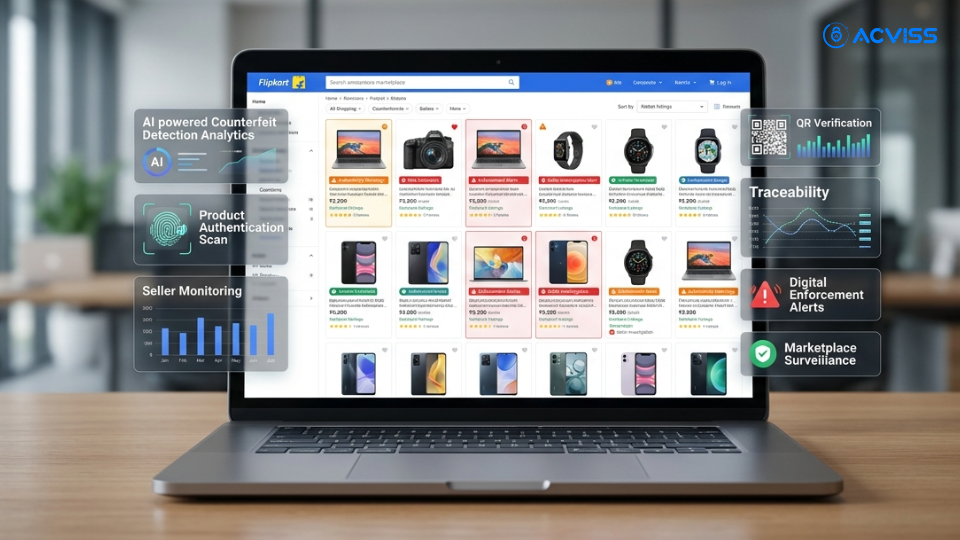
When a pack carries an identity that customers can check, every check becomes a data point. Certify, Acviss’s product authentication solution, returns a verification result and records the event, which the brand can review through a dashboard or its own systems.
Origin, Acviss’s supply-chain track-and-trace solution, adds scan events at production and distribution hand-offs, so unusual movement can be investigated. Neither proves counterfeiting alone. They tell the team where to look.
Know what you can measure
Find out what a verifiable identity on your products would let you measure.
Why ROI cases fail in the budget meeting
These are patterns that follow from how the costs and benefits are distributed, offered as analysis rather than findings from any one company.
No baseline
If nobody counted listings, complaints or price gaps before the programme, there is nothing to compare against. A gain that cannot be shown is treated as a gain that did not happen.
No owner
The benefit lands in sales, the cost sits in legal or marketing, and the data sits with whoever runs the tool. Without one named owner who reports across all three, each department sees only its own slice and the programme looks expensive.
Wrong time horizon
Enforcement costs arrive in the first quarter. Trust and channel effects take longer. A twelve-month view is fair, but a three-month review will usually show cost and little else.
What to track from the first month
| Signal | Where it is counted | Caution |
|---|---|---|
| Listings and sellers found, and actions taken | Enforcement log | Rises when monitoring starts |
| Time from detection to action | Enforcement log | Depends on platform response |
| Verification checks and unusual activity | Authentication dashboard | A flag is a lead, not proof |
| Customer complaints about fakes | Support records | Needs consistent tagging |
| Price gaps and unauthorised sellers | Sales and channel reports | Mixes grey market and counterfeit |
| Legal and counsel spend on infringement | Finance | Lags behind the cases it pays for |
Start the log before you start the programme. The intelligence versus monitoring distinction is worth understanding when you choose what to record, because a list of listings is not the same as an understanding of who is behind them.
Counting the cost side
The cost side deserves the same discipline. A fair account includes the identity and carrier on the pack, integration with production and sales systems, monitoring and enforcement time, external counsel, and the hours someone spends reviewing flags. A programme that counts only the software fee will look cheaper than it is, and will be accused of it later.
A five-step way to build the case
A finance-ready case is built in a fixed order, and skipping a step is what usually makes the numbers collapse later.
1. Set the baseline
Spend the first month counting what already exists: listings, unauthorised sellers, complaints, price gaps and legal spend. This is the comparison point for everything that follows.
2. Limit the scope
Choose the products and channels with the most exposure. A narrow scope produces cleaner evidence than a broad one.
3. Name one owner
Give one person responsibility for reporting across sales, legal and support, so the benefits and costs are read together.
4. Record cost from day one
Log software, integration, review time and counsel spend as they occur. Reconstructing them later invites challenge.
5. Review on two clocks
Judge activity measures at three months and commercial effects at twelve, and state the assumptions behind any estimate of revenue protected.
What the return will not show
A prevented loss is a counterfactual. Nobody can count the sale that did not go to a fake. Any claim to do so should come with its assumptions.
A programme that starts looking also starts finding. Early numbers can look worse before they look better, because the problem was already there and nobody was counting it.
Attribution is the last trap. If sales rise after a rollout, other things changed too: pricing, distribution, season. The Kitply case study is an example worth reading with that question in mind.
Common questions
Can brand protection ROI be calculated precisely?
Only the cost side and the enforcement activity can be counted exactly. Revenue protected is an estimate, and it should be presented with its assumptions and a range.
Why do early numbers sometimes look worse?
Because monitoring finds problems that were already there. A rise in listings found in the first quarter usually reflects better visibility, not a worse market.
The record is the return
The strongest case for brand protection is rarely one figure. It is a record kept over time of what was found, what was done and what stopped happening.
That matters more as evidence expectations rise. Regulators, platforms and boards increasingly ask brands to show how they identify genuine product and handle abuse, not just to say that they do. Brands that keep the record can argue for next year’s budget with evidence, and answer the harder question of what they would have lost without it.
Interested to learn more? Get in touch with us
Talk to Acviss about building the evidence behind your brand protection budget.