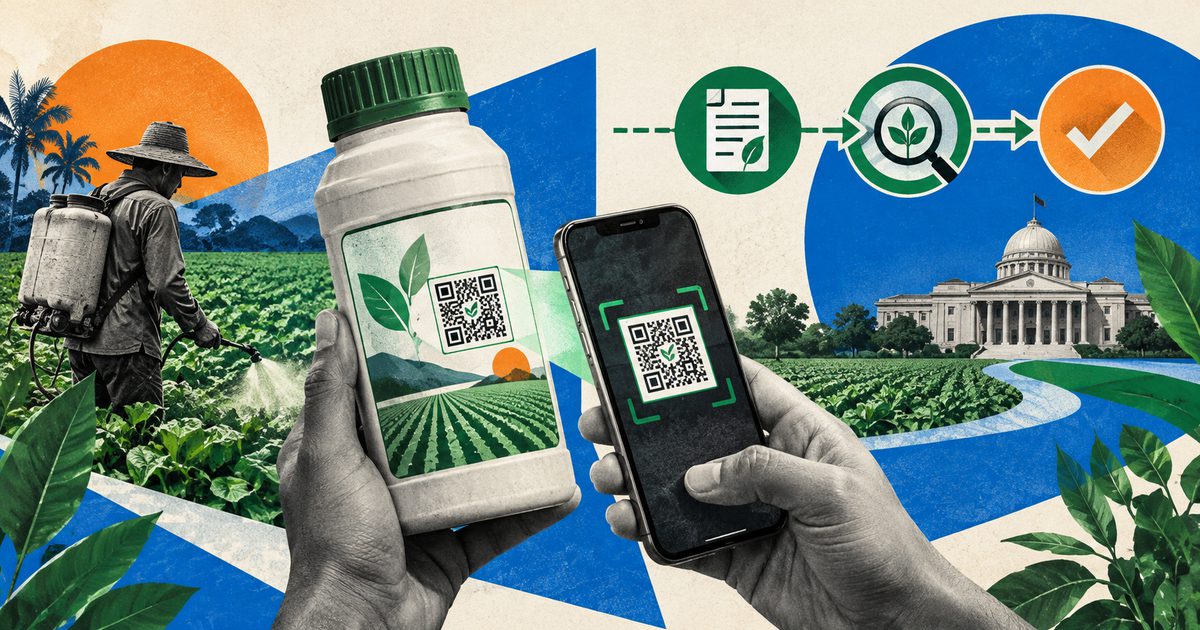
- The Insecticides (Amendment) Rules, 2025 (G.S.R. 367(E), 3 June 2025) require a QR code on the retail pack of household insecticides for cockroaches, mosquitoes, houseflies and bed bugs.
- Scanning must show the manufacturer’s URL, which leads to the full leaflet, and the code must contain the contents of rule 18(1).
- The rule took effect on publication, 3 June 2025. The gazette text contains no transition or sell-off period.
- A link to a leaflet page is compliance, not authentication: a counterfeiter can print the same code on a fake pack.
- A per-unit, non-clonable code such as Certify can satisfy the rule and prove the pack, with Origin linking dispatch records to the same identity.
Since 3 June 2025, household insecticide packs in India have a QR code requirement written into the Insecticides Rules. Many brands treated it as a printing job: generate a code, point it at a web page, move on. That meets the letter of the rule. It does nothing to stop a fake can of mosquito spray from reaching a shelf.
The requirement comes from the Insecticides (Amendment) Rules, 2025, notified by the Ministry of Agriculture and Farmers Welfare as G.S.R. 367(E) on 3 June 2025. It applies to a specific group of products, so the first job is to check whether yours are in it.
What the rule actually says
The gazette text adds a proviso to rule 18(1)(u) of the Insecticides Rules, 1971. It says the Quick Response (QR) code referred to in rule 19(1)(i) must be placed on the retail pack, primary or secondary, of insecticides commonly used for household purposes. The notification names the use: control of cockroaches, mosquitoes, houseflies and bed bugs only.
It then sets out what happens on a scan. Scanning the code with a mobile phone or other scanning equipment must show a web link, the URL of the manufacturing company. Clicking it must take the user to the entire unique information of the leaflet. The QR code itself must contain all the contents of rule 18(1), the information the rules require on the label and leaflet.
Three details are easy to miss:
- The scope is narrow. The gazette text ties the QR proviso to household insecticides for those four pests. Several summaries online describe it as covering insecticides in general. If your portfolio mixes household and agricultural products, read the notification against each product before you assume either way.
- It took effect on publication. The rules say they come into force on the date of their publication in the Official Gazette, 3 June 2025. The notification contains no transition or sell-off period for the QR requirement. Claims of a six-month or 30-month window that appear in some commentary are not in this text.
- It followed consultation. The draft was published as G.S.R. 507(E) on 20 August 2024, and the Central Government considered the objections and suggestions it received.
The intent is sensible. A scan gives a householder the leaflet, the safety and usage instructions and a route to the manufacturer without reading small print on the can.
Why compliance is not authentication
A compliance QR code points to a page. Anyone can print a QR code that points to the same page.
Think about what a counterfeiter needs. They copy the pack design and the label. They add the same QR code, because it is only a link to the manufacturer’s genuine web page. A buyer who scans it lands on a real, professional page about a real product and concludes the pack is genuine. The scan has done the counterfeiter’s job for them.
This is the difference between compliance and protection. A QR code that links to a manufacturer URL tells you where information lives. It cannot tell you whether this unit came from the factory. For that you need a code that is unique to each unit, cannot be copied by photographing it, and returns a different answer the second time it is scanned.
Household insecticides make this a live issue. They are low-ticket, high-volume goods sold through general stores, kirana shops and online marketplaces, which are exactly the channels where look-alike packs travel. A fake product that does not work is a brand problem. A fake that is diluted or contains the wrong active ingredient is also a safety problem, because the product is used in homes. Read more on how counterfeiting reaches consumer goods and why the check has to happen at the shelf.

See Certify in action
Make the code on your pack unique per unit so a buyer can verify it with a phone scan, no app needed.
Explore Certify
Compliance QR versus a code that proves the pack
| Question | Compliance QR (link to leaflet) | Non-clonable per-unit code |
|---|---|---|
| Satisfies the 2025 rule? | Yes | Yes, when it also opens the manufacturer’s leaflet page and carries the rule 18(1) contents |
| Unique to each pack? | No, usually one link per product | Yes, one identity per unit |
| Survives being photographed and reprinted? | No, a copy scans the same | Designed to, because a repeat or impossible scan is flagged |
| Tells the buyer the pack is genuine? | No, it shows the product page only | Yes, it returns a verified or suspect result |
| Tells you where fakes surface? | No | Yes, scan data shows location and frequency |
The right-hand column does not replace the left. The leaflet link is still required. The point is that the same code can do both jobs when it is designed that way from the start.
How to meet the rule and protect the pack
Keep the compliance link. Whatever you build, the code must still open the manufacturer’s page with the full leaflet and carry the rule 18(1) contents. Do not trade that away.
Make the code unique per unit. Each pack gets its own identity. A genuine unit can be verified, and a second scan from a different place is flagged. A fake cannot reproduce that property.
Verify without an app. Shoppers will not install an app to check a can of spray. A WhatsApp or web scan works with the phone they already carry. Acviss Certify is built for this: a per-unit code with the result returned in seconds and no app to download.
Tie the code to your supply chain. Knowing a unit is genuine is stronger when you also know where it was meant to go. If a pack surfaces in a region you never shipped to, that is a signal. Origin links production and dispatch records to the same product identity.
Use the scan data. Every verification is a data point. Clusters of failed scans in one city tell you where to act. For how the main code types compare, see our glossary entry on secure QR codes.

What to do now
Check each SKU against the notification and confirm whether it falls under the household insecticide proviso. Then decide whether the code on your pack will be a link or an identity. If you are about to commission label changes to meet the 2025 rule, that is the cheapest moment to make the code unique per unit. Doing it later means a second round of artwork and printing.
If you would like to see how a compliant code and a verifiable code can be the same code, talk to the Acviss team.
Source: Insecticides (Amendment) Rules, 2025, G.S.R. 367(E), Ministry of Agriculture and Farmers Welfare, 3 June 2025 (Gazette of India, Extraordinary, Part II, Section 3(i)), rule 3 and the gazette text as reproduced by World Trade Scanner.

Turn a compliance QR into proof the pack is genuine
Book a free demo and see how Certify makes the same code meet the 2025 rule and stop copies.
Book a Free Demo
Related reading

Best Systech Alternatives for Product Authentication (2026)
A brand protection lead usually starts looking past Systech for one of two reasons. Either the counterfeit problem has moved online, onto Am

BIS/ISI Mark Counterfeiting: Fake Safety Certifications on Electronics
A charger sold on a marketplace in India carries a printed ISI mark and a licence number. The mark looks correct. The number looks plausible