- Why export markets are the easier target, not the harder one
- Which Indian export categories get hit hardest
- What “monitoring” means when the fake never touches Indian soil
- Building export-side brand protection into the go-to-market plan
- The part of the counterfeit problem Indian exporters are watching least
Indian Brands Counterfeited Abroad: The Export-Side Problem

- Almost every counterfeiting story about India runs one direction: fakes coming in. This post covers the opposite flow, an Indian brand’s own product counterfeited in the market it exports to.
- Export markets in Africa, the Middle East, and Southeast Asia are easier to counterfeit in, not harder, because enforcement infrastructure is weaker and the brand’s own monitoring rarely extends past India.
- Generic pharmaceuticals are the highest-profile case, but spices, textiles, and ayurvedic products carry the same exposure.
- Domestic marketplace monitoring protects nothing once the product and the fake are both outside India. Exporters need in-market monitoring and authentication that travels with the product.
TL;DR
- Almost every counterfeiting story about India runs one direction: fakes coming in. This post is about the opposite flow, an Indian brand’s own product counterfeited in the market it exports to.
- Export markets in Africa, the Middle East, and Southeast Asia are easier to counterfeit in, not harder, because enforcement infrastructure is weaker there and the brand’s own monitoring rarely extends past India.
- Generic pharmaceuticals are the highest-profile case, but spices, textiles, and ayurvedic products carry the same exposure.
- Domestic marketplace monitoring protects nothing once the product and the fake are both outside India. Exporters need in-market monitoring and authentication that travels with the product.
Every counterfeiting story about India runs the same direction. A fake charger shows up on a marketplace in Mumbai. A counterfeit hologram gets caught at a Delhi retail counter. A shipment of adulterated pesticide is seized before it reaches a farmer in Maharashtra. The frame is always the same: fakes coming into India, an Indian brand or an Indian consumer on the receiving end. Acviss has covered that domestic side of the problem before, including how grey market diversion steals Indian brand revenue inside India itself.
Flip the camera and there’s a second problem nobody writes about. An Indian pharmaceutical company ships a batch of generics into Nigeria. An Indian spice brand’s masala blend sells across the Middle East. An Indian ayurvedic label builds a following in the US and Germany. In each case, the brand’s own trademark, packaging, and product identity can get counterfeited in that export market, by someone who has never touched the real supply chain and never will.
This isn’t a quality-control failure on the Indian manufacturer’s part. It’s a brand-protection failure with no domestic remedy, because the fake never enters India at all. It’s made, sold, and consumed entirely outside the one country where the brand actually has monitoring, legal relationships, and enforcement muscle.
Why export markets are the easier target, not the harder one
The same conditions that make a market attractive to export into also make it easy to counterfeit in. Weaker IP and customs enforcement in parts of Africa, the Middle East, and Southeast Asia means a counterfeiter faces less risk of getting caught than they would trying the same thing inside India, where enforcement has been getting more active in recent years, including on the CDSCO traceability requirements now shaping domestic pharma compliance.
Distance compounds the gap. An Indian brand’s field investigators, its retail relationships, its legal counsel, all of it is built around India. None of that presence exists in the country the product is actually being exported to. A counterfeit surfacing on a market stall in Lagos or a souq stand in Dubai is invisible to a monitoring setup that was only ever pointed at Indian marketplaces and Indian social media.
There’s a gap on the home side too. Indian Customs can only act on suspected-infringing exports when it’s given advance information about a specific shipment. There’s no proactive screening of outbound goods working in an exporter’s favour by default. So the enforcement gap runs on both ends: the origin country has no structural reason to stop goods leaving, and the destination country often lacks the capacity to catch a fake made locally, or shipped in from elsewhere, under an Indian brand’s name.
Which Indian export categories get hit hardest
The categories with the strongest export brand equity are exactly the ones exposed abroad.
Generic pharmaceuticals are the headline case. India is often called the pharmacy of the world, and Indian-origin generics are frequently cited as the largest single national source of medicines seized as counterfeit globally [UNVERIFIED: needs primary OECD/EUIPO source for this figure]. Counterfeit and substandard pharmaceuticals are a well-documented crisis in African markets specifically, with regulators and customs agencies across the continent reporting large seizures of fake and mislabelled medicines on a recurring basis.
It’s worth being precise here, because two different problems get conflated constantly. One is manufacturer-side: reporting on Nigeria’s pharmaceutical enforcement shows Indian-based manufacturers themselves rebranding restricted drugs, such as Tramadol relabelled as “Tafrodol,” specifically to evade Nigerian customs controls on a banned opioid. That’s illicit sourcing and relabelling at the point of manufacture, not a third party counterfeiting an established Indian brand’s actual trademark. The problem this post is about is the second, distinct one: someone with no connection to the real supply chain copying a genuine, legitimately-exported Indian brand’s packaging and trademark once it’s already established a customer base abroad. A specific, named, checkable case of that exact second pattern (branded, established Indian FMCG or pharma product counterfeited by an unrelated third party in an export market) is [UNVERIFIED: needs a specific sourced case] as of this writing, but the enforcement-gap conditions described above make it a predictable outcome as more Indian brands build export equity.
Spices carry the same exposure at a smaller unit price. Turmeric, cardamom, cumin, and blended masalas built recognisable brand equity abroad well before anyone thought to protect it there. A counterfeiter doesn’t need to fake a complex product, just a package and a name shoppers already trust, filled with cheaper fillers or adulterants.
Textiles exported to the Middle East, the EU, and the US face the same risk, especially where a craft or regional origin claim (handloom sarees, GI-tagged weaves) is part of what the buyer is actually paying for. That provenance claim is precisely what’s easiest to counterfeit once the genuine product is out of India and out of sight.
Ayurvedic and wellness products are the newest entrant on this list. Herbal oils, supplements, and skincare are gaining real share in the US, Australia, and Germany. Lower regulatory friction in some of these markets makes packaging counterfeiting simpler, not harder, for anyone looking to ride an Indian brand’s growing reputation.

See Truviss in action
See how Truviss monitors marketplaces and social platforms beyond India, so an export-market counterfeit doesn’t stay invisible.
Explore Truviss
What “monitoring” means when the fake never touches Indian soil
Most Indian brand-protection effort defaults to a domestic-first posture: watch Indian marketplaces, watch Indian social media, audit Indian distributors. That’s a sensible starting point, and it has zero visibility into a counterfeit sold on a market stall in Lagos, listed on a regional e-commerce platform in Southeast Asia, or moving through informal retail in the Gulf. This is a form of brand exposure that sits alongside the more familiar anti-counterfeiting fight brands already run domestically, just aimed at a market the brand has never had to defend before.
What’s actually needed is monitoring built for the destination market itself, not the home market. That means scanning the marketplaces and social-commerce channels people in that country actually use, running periodic distributor and retail spot checks on the ground, and giving the product itself a way to prove authenticity without depending on local enforcement capacity to back it up.
This is where Truviss fits. It’s built to monitor marketplaces, social platforms, and domains well beyond any single country’s borders, which matters here specifically because the fake in question was never going to surface on an Indian platform in the first place. A brand watching only its home turf will simply never see the listing that’s actually costing it sales and reputation abroad.

Building export-side brand protection into the go-to-market plan
This has to be planned at the point of export, not bolted on after the first fake surfaces in a market the brand barely tracks.
Three pieces matter here. Cross-border online monitoring extends brand surveillance to the marketplaces and social platforms actually in use in the destination country, not just the ones familiar from the Indian market. Physical authentication that travels with the product means a security code or label that works the same way whether it’s scanned in Mumbai or Lagos, with no dependency on the destination country’s enforcement infrastructure to be useful to a genuine buyer, distributor, or customs officer. And supply chain visibility into the export leg itself means knowing where a shipment actually went, and where a counterfeit copy might have entered the chain, not just tracking distribution inside India.
Truviss covers the first piece: cross-border monitoring of the marketplaces and social channels where an export-market counterfeit is actually going to surface. Certify covers the second: a unique, scannable identity on the product itself, so a distributor, retailer, or customs official in Lagos or Dubai can check authenticity in seconds without needing to contact anyone in India. Origin becomes relevant as a third layer for brands that need visibility into the export shipment itself, tracking where product actually moved once it left the factory, though for most exporters the first two are where the exposure is sharpest.

The part of the counterfeit problem Indian exporters are watching least
Export growth is a genuine success story for Indian pharma, FMCG, textiles, spices, and ayurvedic brands. It’s also quietly building a new kind of exposure that domestic-first brand protection was never designed to catch. India’s own enforcement strength does nothing for a brand once its product, and its name, cross a border into a market where nobody’s watching.
If your brand sells outside India and your monitoring stops at the Indian border, that’s worth a closer look before the first counterfeit report comes in from a market you’ve never had eyes on. Book a demo to talk through cross-border brand monitoring, or see how other brands have handled it in our case studies.

Is your brand monitoring stopping at the Indian border?
Book a free demo and see how Truviss and Certify extend brand protection to the export markets you’re actually selling into.
Book a Free Demo
Related reading
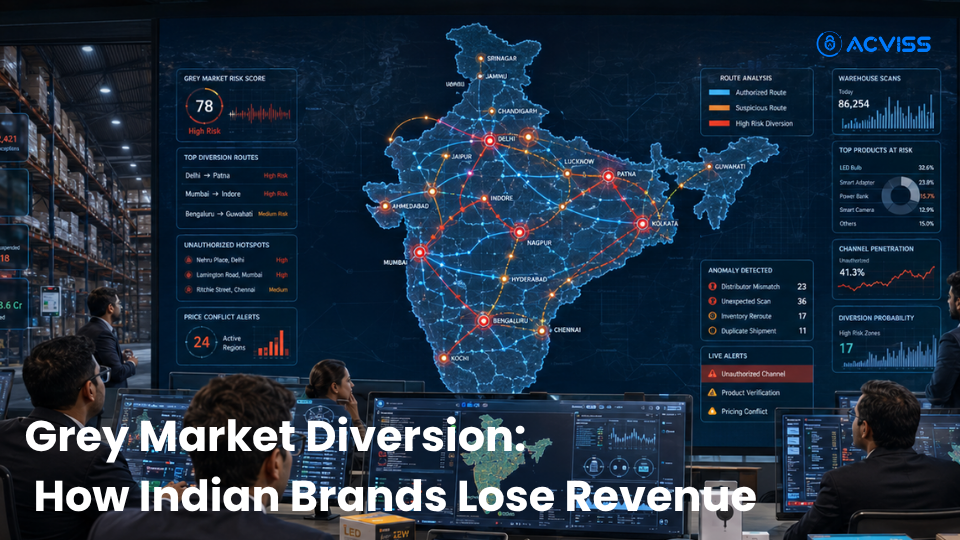
How Grey Market Diversion Steals Indian Brand Revenue
What-is-Grey-Market-Diversion-How-Indian-Brands-Lose-Revenue-Without-Knowing
What Indian Pharma Must Know About CDSCO Traceability Requirements 2026
In this article What Is CDSCO and What Role Does It Play in Drug Traceability? Current Traceability Requirements for Indian