- What a hologram does well
- Where a hologram stops
- What a unique identity adds
- Hologram vs tech-based authentication: what each one can prove
- Regulation already asks for both in some sectors
- Procurement mistakes that decide the outcome
- A decision framework: five questions
- How Certify maps to this
- Common questions
- The check is the product
 Arun KrishnanOct 01, 20267 min read

For decades the hologram has been the mark most shoppers associate with a genuine product. It sits on cartons, labels and blister packs and tells a quick visual story: this was made by someone who cared enough to protect it.
The real question in hologram vs tech-based authentication is not whether holograms are good or bad. It is what a hologram can tell you, what it cannot, and what a unique digital identity adds. The scale of the problem keeps that question live. EU customs and enforcement authorities detained 112 million counterfeit items in 2024, with an estimated retail value of €3.8 billion, the highest value on record.
- A hologram is a strong visual signal that works without a device or a network, but it tells the brand nothing and identifies no single unit.
- A unique identity checked against a record can answer more questions. The two work best as layers, not rivals.
What a hologram does well
The EUIPO’s anti-counterfeiting technology guide describes holograms as optical devices whose image changes with lighting and viewing angle, and notes they cannot be reproduced by colour printers, scanners or cameras. Their complexity can be raised by adding images and effects.
A hologram is checked by eye, which is why a hologram label still works on a shelf, in a warehouse or in a shop with no signal. It is a classic overt authentication feature: it is visible without any equipment. For a distributor, a customs officer or a trained inspector, that immediacy is hard to replace.
Where a hologram stops
The same guide adds a limit. Successful authentication of a hologram requires knowledge of the original, used as a comparison. A trained inspector can do that. A shopper usually cannot.
A standard hologram also carries the same design across a run, so it shows that a design is present, not which unit it is on. By itself it returns nothing to the brand: no record of a check, no pattern across regions, no signal that the same label has been applied to many packs.
There is a practical consequence for investigations. If a suspect pack arrives with a convincing hologram, the brand has no way to ask which production run, which converter or which shipment the label came from. That question can only be answered if the label carries something unique.
In investigation terms, a hologram supports the first look and an identity supports the second. The first decides whether a pack deserves suspicion. The second says where it was issued, whether it was checked before and by whom.
What a unique identity adds

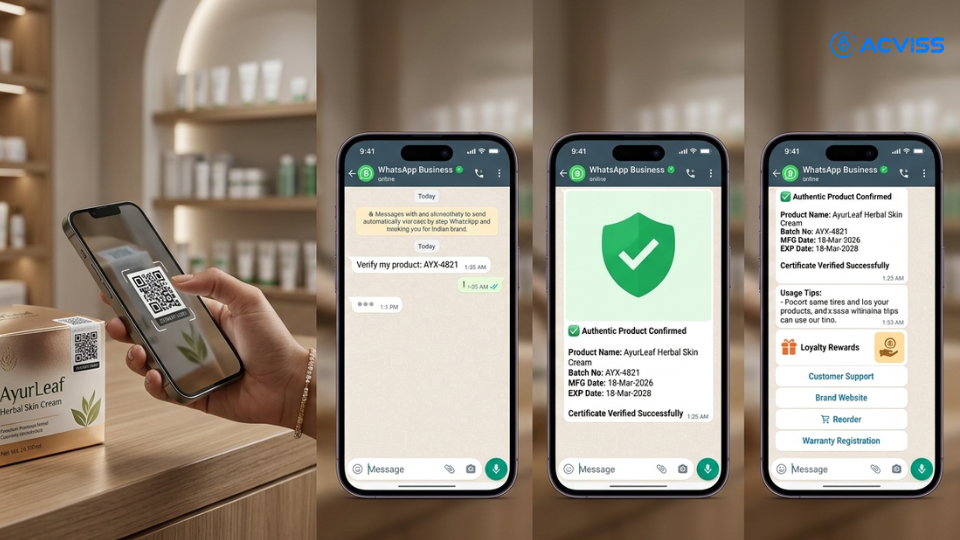
A unique identity assigns each unit, pack or batch its own identifier and records it in a system. A check against that record can say whether the identifier was issued, and the brand can review the check as an event.
The carrier is often a QR code, which is a data carrier and nothing more. The EUIPO guide is direct about this: QR codes by themselves do not offer protection against copies, but they can be combined with other authentication technologies, such as holograms, copy detection patterns or unique identifiers, to provide automated authentication through a smartphone scan. See the glossary entries on secure QR codes and product verification.
The weakness is the mirror image of the hologram’s. An identity needs a working check, someone to look at the results and a way to cope with a copied carrier that points to a real identifier. Without those, the QR code is decoration.
Hologram vs tech-based authentication: what each one can prove
| Question | Hologram alone | Unique identity with verification |
|---|---|---|
| Who can check it? | Anyone who knows what the original looks like | Anyone with a supported channel, such as an app or a scan |
| Does it identify one unit? | No, the design is shared across a run | Yes, each identifier is separate |
| What does the brand learn? | Nothing from the check itself | Verification events it can review |
| Does it show tampering? | It can, depending on material and adhesive | Not by itself, it needs a physical tamper layer |
| What can defeat it? | A skilled copy of the design | A copied carrier that points to a real identifier |
Neither column is complete. That is the point.
What can your label actually prove?
See which questions your current labels can and cannot answer.
Regulation already asks for both in some sectors
Prescription medicines in the EU show the layered logic in law. Under Delegated Regulation 2016/161, packs must carry a unique identifier and an anti-tampering device. One identifies the pack. The other shows it has not been opened.
The wider principle holds outside pharma: identity and physical integrity answer different questions, so a pack can need both. The ISO standard on selecting authentication solutions, ISO 22383:2020, frames the choice as a fit between the threat and the solution over the product’s life cycle, not as a ranking of technologies.
Procurement mistakes that decide the outcome
The patterns below are analysis of how label programmes are typically bought and run, not findings from a single deployment.
Buying on price per label
Unit price is easy to compare and misleading. A cheaper label that gives the brand no data, or one that needs a manual process to reconcile with production, moves cost to the factory floor and the brand-protection team. Our note on authentication software costs sets out where those costs sit.
Treating the label supplier as the whole programme
A hologram supplier, a converter and a label applicator form a working chain with contracts and procedures behind it. Changing one link affects the others. Many brands read this debate as a vendor switch, when the lower-risk path is to keep the physical element and add the identity layer.
Skipping the inspector and dealer side
A hologram nobody knows how to read protects nothing, and an identity nobody checks protects nothing either. Training distributors, dealers and field staff on what a genuine label looks like and what a check returns is part of the cost of either option.
No plan for relabelling and returns
Labels get reprinted, stock gets relabelled and returns come back in the wrong pack. If the programme does not say what happens to an identifier in those cases, genuine stock produces false anomalies, and the team stops trusting the alerts.
A decision framework: five questions
Instead of choosing between a hologram and an identity, test each option against the threat.
- Who needs to check, and with what equipment?
- Does the answer need to identify one unit or only the batch?
- What must the brand learn from each check?
- What happens when a check fails, and who acts?
- How will the choice survive a change of converter, region or label design?
High-volume goods sold through informal channels usually need the visual signal. Goods where diversion and warranty claims matter usually need the identity record. Many categories need both. Our holographic labels buyer’s guide covers what to ask a vendor, and the three-way comparison sets hologram against QR and invisible layers.
How Certify maps to this
Certify is Acviss’s product authentication solution, a digital identity and verification layer. An identity is created for a unit, pack, carton or batch, associated with a supported carrier, and checked through a supported channel. The system returns a result and records the event, which the brand sees through a dashboard or an integration.
Two boundaries apply. A hologram is a physical element, while the embedded identity and the backend check are separate layers. And a valid identity does not by itself prove that a carrier has not been copied, so unusual check activity still needs review. The difference between detecting and preventing copies is covered in our note on copy detection.
Common questions
Can a hologram be combined with a QR code?
Yes, and the EUIPO guide describes exactly that combination. The hologram supplies the visual, device-free signal, and the QR code carries the unique identifier that the backend check uses.
Does a unique identity stop copying?
Not by itself. It makes copying detectable when a carrier is reused or an identifier appears where it should not. Preventing a copied carrier from passing needs a physical layer as well.
Which comes first when budget is limited?
It depends on the threat. If the problem is counterfeit goods sold openly, the visual layer is the quicker win. If it is diversion, warranty abuse or unclear provenance, the identity record answers more questions.
The check is the product
A label does not protect a brand. A check does, along with whoever acts on it. The hologram makes that check easy to start. The identity makes it possible to learn from.
As more markets ask brands for product-level data, labels that only look secure will be asked what they can show. The programmes that adapt will be those that treated the label as the start of a record, and compared options against the questions an investigator, a regulator or a retail partner might ask. For the full range of methods, see our guide to product authentication.
Add a verification layer to your labels
Talk to Acviss about adding a verification layer to the labels you already use.