Arun KrishnanNov 05, 20267 min read

Most advice on social media brand protection starts with a reporting form. A strategy has to start earlier, with a harder question: what counts as yours, and how can anyone else tell?
Social platforms differ from marketplaces in ways that shape everything after that. An account takes minutes to open. The sale often moves into a private message or a group chat, where a brand cannot search it the way it can search a public listing. WhatsApp messages, for example, are end-to-end encrypted by default.
- Social media brand protection works in four moves: define what is official, watch for lookalikes, report with evidence through each platform’s rights-holder route, and keep the case history.
- Reporting tools usually need a registered trademark. Without one, most of the strategy stalls.
Why social platforms need their own strategy
The scale of harm is visible in consumer data. The US Federal Trade Commission’s Data Spotlight on social media scams reported US$2.7 billion in losses since 2021, higher than for any other contact method, with online shopping among the most frequently reported categories. The FTC notes that reports capture only part of the real total. Those figures describe American consumers, but the mechanics travel: a fake persona, a copied product photo and a payment link.
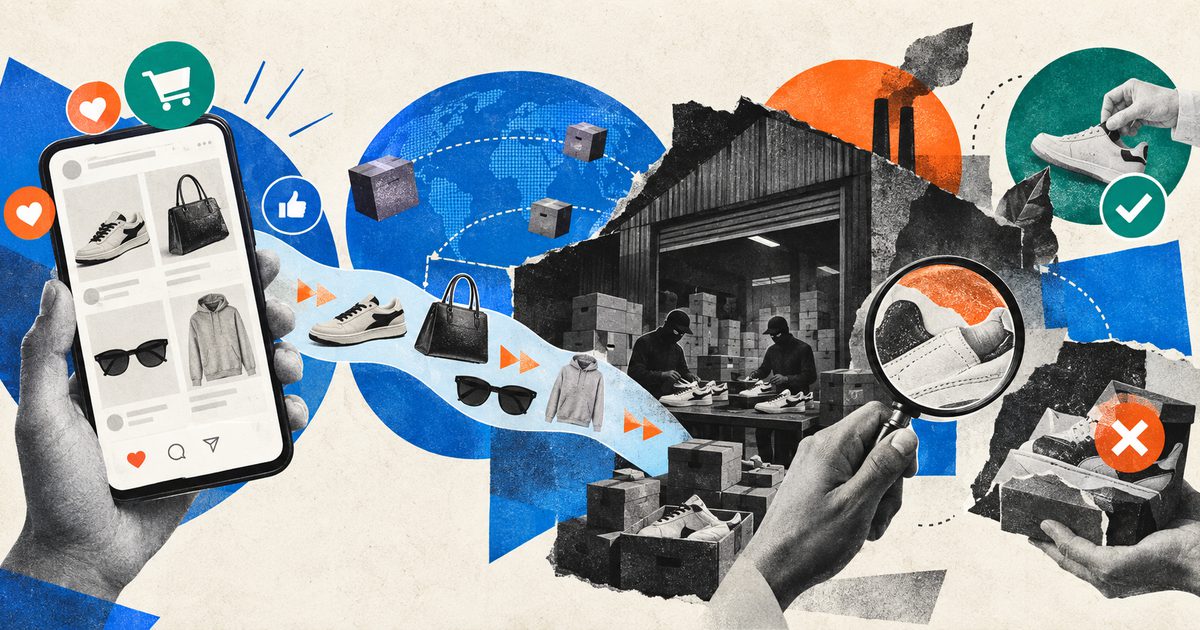
The abuse takes several distinct forms, and each needs a different response. Fake official pages and profiles are the clearest case of brand impersonation. Counterfeit sellers use posts, shops and direct messages, the territory covered in our piece on social commerce.
Scams borrow a brand’s name to collect money or data, such as fake giveaways that end at a cloned checkout. Lookalike domains, linked from a bio or comment, send followers to a page the brand does not own.
The common thread is impersonation of identity, not only of product. This guide covers the strategy above those tactics. For the steps on a single account, start with our notes on fraud on social media.
A strategy in four moves
1. Define what is official
List every official handle, page and domain, and publish that list on your own website. Followers and support teams then have something to check a suspicious account against. Where a platform offers account verification, use it.
A useful register records, for each account, the platform, handle, owner, creation date, who holds admin access and the recovery contact. It should also settle who in the company may open new accounts, because well-meaning “regional” pages created by staff look exactly like impersonation and waste review time.
Register the trademark in each market where you sell, because rights-holder programmes depend on it. Meta’s Brand Rights Protection is open to enrolled brands, and enrolment asks for trademark and business details. The practical steps are in our note on how to register a trademark.
2. Watch for lookalikes and new accounts
Search for your brand name, product names and logo on each platform on a regular schedule. Note account names that differ by a character or two, profile photos copied from your site, and product photos reused from your catalogue. Record each find with the date and the URL.
Searching is only the first half. Our explanation of brand monitoring against counterfeit intelligence shows why a list of finds is not yet an investigation.
3. Report with evidence through the platform’s own route
Each platform has a rights-holder channel, and they ask for similar things: proof of the right, the exact location of the content and a clear statement of why it infringes. Instagram’s Counterfeit Report Form, for example, asks for the trademark registration certificate or a screenshot from the registry.
In the EU, the Digital Services Act requires online platforms to provide notice-and-action mechanisms and to give priority to notices from trusted flaggers, which is worth knowing if you operate there (Regulation (EU) 2022/2065). Keep the screenshots and timestamps even after a report is accepted. They matter if the account returns, and they support any later legal step, as set out in our note on safe harbour.
4. Keep the case history
A removed account is a closed ticket, not a closed problem. Counterfeit sellers reopen under new names, often with the same product photos and the same payment details. Store every case with its evidence and outcome, and tag repeat accounts so the second appearance is spotted on the first day.
Review the case record monthly. Look for repeated product photos, shared payment details, similar account names and the same destination links. Patterns across cases, not single removals, show whether you face one persistent seller or many unrelated ones.
Turn scattered finds into one case record
Talk to Acviss about monitoring, review and evidence for your brand on social platforms.
Matching the abuse to the response
A single report template does not work for every case. The table below is analysis of which route usually fits, and the right choice still depends on the platform and the jurisdiction.
| What you find | Usual first response | Evidence to keep |
|---|---|---|
| Fake official page or profile | Impersonation report on the platform | Page URL, screenshots of copied logo and name, date first seen |
| Counterfeit goods for sale | Rights-holder or counterfeit report with the trademark proof | Listing or post URL, product photos, seller identifier |
| Giveaway or payment scam | Scam report, warning to followers, domain complaint if a clone page is involved | Post, linked page, payment details shown |
| Genuine product resold outside the network | Channel-control action with the seller, not a counterfeit report | Proof of authorised-seller list, listing details |
Two habits keep this honest. Capture the evidence before you report, because a removed post cannot be screenshotted afterwards. And record which label you chose and why, so a later reviewer can see whether the report matched the facts.
Where manual monitoring runs out
A person can check a handful of platforms weekly. Across several platforms, several product lines and several markets, the volume of new accounts and posts outgrows a spreadsheet, and the second sighting of a repeat account is easy to miss.
Truviss is Acviss’s online brand protection solution. A team first onboards its trademarks, product images, brand assets and authorised sellers. Truviss then monitors the selected online channels for matches and suspicious similarities, and uses rules or models to prioritise what looks most likely to be infringing.
A person reviews each flagged item with its supporting evidence. The team then authorises, routes or files the right platform action, and the case and its outcome stay available for reporting and follow-up. A flag is a lead, not proof of counterfeiting, and enforcement still depends on legal basis, platform process and human judgement. For the wider picture, see our online brand protection guide.
Where social media programmes go wrong
These patterns are analysis of how brand programmes commonly fail, not findings from a single client.
Reporting before the rights are in place
A brand with no registered trademark in the relevant market has little to attach a complaint to, and reports are slower or refused. Registration comes first.
Treating removal as the finish
Without a case history, the same seller returns under a new name and the team starts again from nothing.
Ignoring private channels
Buyers see the offer in a direct message or group, not in public. Encourage customers and distributors to send screenshots to a named address, because they often hold the only evidence.
Calling every unauthorised seller a counterfeiter
A genuine product resold outside the approved network is a different problem, as we explain in counterfeit vs grey market. Using the wrong label weakens the report.
No owner and no cadence
Marketing sees the fake page, legal holds the trademark and customer support hears the complaints. Without one named owner and a regular review, finds stay scattered and nobody connects them.
Common questions
Do I need a registered trademark to report a fake account?
Usually yes for counterfeit and trademark reports, because platform forms ask for proof of the right. Some impersonation reports can be made without one, but processes differ by platform.
Can I monitor WhatsApp or private groups?
Not directly. Encrypted channels are not searchable by brands, so the practical route is to collect evidence from customers, distributors and public posts that point to the private channel.
Is removal enough?
No. Removal ends one account. A case record and a review of repeat accounts are what stop the next one from starting at zero.
From takedowns to a standing practice
Social media gave brands cheap reach and gave imitators the same thing. As regulators push platforms towards faster notice handling and more accountability for sellers, the brands that benefit most will be those that arrive with a verified list of official accounts, a registered right, and clean evidence.
Treated as a standing practice rather than a series of incidents, protection costs less per case and spots repeats earlier.
Platform policies change often, so the register and the playbook should carry a review date. The person who owns them should check each platform’s current rights-holder process at least twice a year.
Interested to learn more? Get in touch with us
See how Acviss supports monitoring, review and evidence for brand abuse online.
Related reading

Lazada and What Brand Protection Actually Requires Across Southeast Asia
Selling on Lazada across Indonesia, Vietnam, the Philippines, Thailand, Malaysia and Singapore? Why brand protection…

Noon and What Brand Protection Actually Requires in the Middle East
Selling on noon or Amazon in the UAE and Saudi Arabia? Why Gulf brand protection starts with local trademarks, customs…

The Growing Need for Brand Security in the Digital Age
Protecting brand security in the digital age from counterfeits, impersonation, and cyber threats with AI-powered brand…